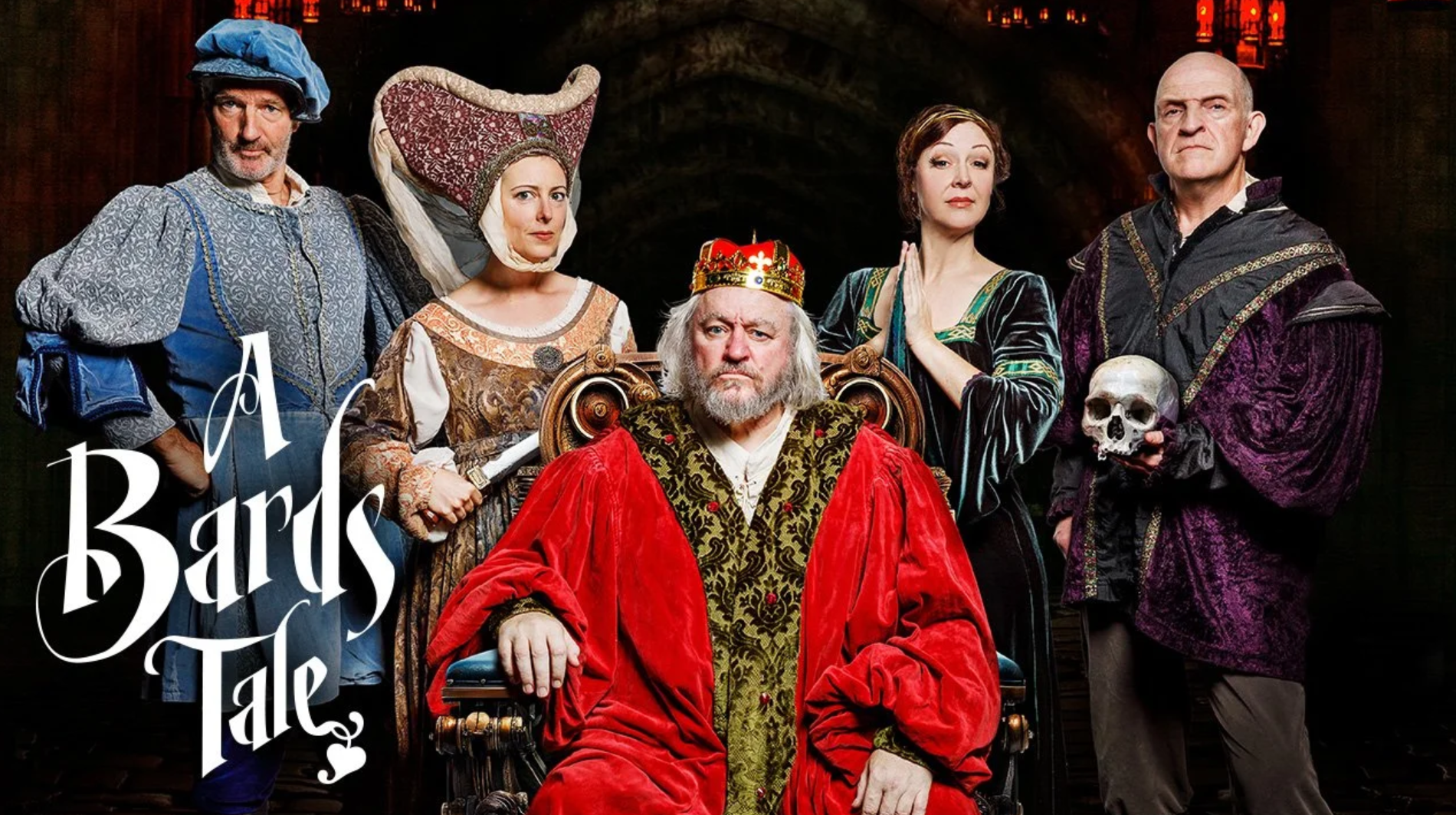
A Bard’s Tale – the greatest plays Shakespeare never wrote. The cast performs a full-length play in the style of the greatest playwright that ever lived. A Bard’s Tale has been performed at the Pop-up Globe and the Hawaiian Improv Festival, and of course – it’s different every night!
There is a unique kind of confidence required to walk onto a stage with no script, no props, no rehearsal, ask an audience for a suggestion, and then spend the next hour performing a Shakespearean epic that has never existed before. A Bard's Tale thrives on exactly that confidence. Produced by Covert Theatre, the long-running improvised comedy transforms a single audience prompt into a full-length play filled with royalty, betrayal, romance, mistaken identities, conspiracies, and enough dramatic reversals to make the Bard himself proud. The remarkable part is not that the cast manages to create a coherent story from nothing. It is how often they make the audience forget the story is being invented in real time.
On this particular evening, Wade Jackson, Kevin Barron, James Ting-Edwards, and Elle Bell took on the impossible task of building an entirely original Shakespearean drama from scratch. Like all strong improv, the success of the show came not from individual jokes but from commitment. Once the performers established the world, they treated every ridiculous twist, every absurd location, and every unexpected relationship as if it were the most important thing ever written. That willingness to fully invest in the reality of the story is what elevates A Bard's Tale beyond novelty and turns it into genuinely engaging theatre.
What makes the format particularly impressive is the complexity hiding beneath the surface. Although it appears effortless from the audience's perspective, there is an enormous amount of structural discipline required to keep the narrative functioning. The performers establish a collection of core characters early and then spend much of the opening act carefully exploring the relationships between them. Characters are paired and re-paired in different combinations, alliances emerge, rivalries develop, secrets begin to form, and before long an intricate network of motivations and obligations is quietly taking shape. By the time the first major conflicts begin colliding, the audience already understands how everyone relates to everyone else.
The result feels surprisingly close to actual Shakespeare. The stories are dense with misunderstandings, social hierarchies, romantic complications, and escalating consequences. The difference is that where Shakespeare spent weeks writing his plots, these performers have only seconds to decide what happens next.
One of the most impressive aspects of the production is its complete lack of physical props. Lesser improv often relies on costume pieces, hats, or simple visual aids to help audiences keep track of different characters. A Bard's Tale dispenses with all of that entirely. Every location, weapon, throne, horse, goblet, castle, and battlefield exists only through mime and physical performance. Instead of grabbing a crown to signal a king, performers reshape their bodies. Posture, movement, gesture, and vocal delivery become the costume.
This places an enormous burden on the cast, but it also gives them incredible freedom. Characters can appear and disappear instantly. A performer can switch from prince to peasant in the space of a few steps simply by altering how they occupy the stage. Watching those transformations happen becomes one of the show's greatest pleasures. There is something deeply satisfying about seeing an actor physically discard one character and immediately embody another using nothing except body language and voice.
Wade Jackson was particularly effective in this regard. His various characters occupied completely different ends of the social spectrum, allowing him to create instantly recognisable distinctions between them. Whether playing someone noble, someone powerless, or someone communicating without words entirely, Jackson displayed the sort of precision that comes from decades of experience. Every role felt physically unique. The audience never needed to be reminded who a character was because Jackson's movement and posture did the work for him.
Kevin Barron took a very different approach, creating a character whose influence lingered over much of the narrative. While other performers juggled multiple identities and constantly shifted between roles, Barron anchored much of the story through a consistent presence that helped hold the increasingly chaotic plot together. It proved a clever strategic choice. Because there was always one stable force operating within the narrative, the audience had something firm to latch onto while the rest of the story spiralled into increasingly entertaining complications.
James Ting-Edwards deserves credit for the sheer amount of narrative work he undertook throughout the evening. Improvised Shakespeare is difficult enough when dealing with a handful of characters, but keeping track of multiple storylines while simultaneously creating dialogue, relationships, and dramatic stakes requires extraordinary concentration. There were moments where some of his characters threatened to blur together as the plot became more complicated, but his ability to listen, react, and support the wider narrative ensured the story remained coherent.
Elle Bell brought a completely different energy to the stage. Where other performers occasionally seemed focused on maintaining structure and plotting, Bell appeared determined to keep introducing possibilities. New complications emerged. New locations appeared. Potential resolutions were delayed. Rather than rushing the story toward a conclusion, Bell consistently found ways to keep the various storylines spinning independently for as long as possible. This proved invaluable to the overall shape of the show because Shakespearean drama thrives on delayed gratification. Secrets are more entertaining when they remain hidden. Lovers are more compelling when circumstances prevent them from meeting. Conflicts become funnier when they are allowed to escalate beyond all reasonable proportion.
That patience paid dividends as the performance progressed. The audience could feel narrative pressure building throughout the evening. Storylines that initially seemed unrelated slowly drifted toward each other. Individual character goals began colliding. Misunderstandings multiplied. The eventual convergence of all those separate threads generated exactly the kind of chaotic theatrical energy that great improvised storytelling requires.
What impressed me most was the cast's respect for the audience suggestion itself. Improvisers under pressure often default to familiar patterns, broad stereotypes, or cheap jokes to keep the momentum going. Here, the central premise offered by the audience remained integral to the story from beginning to end. Rather than treating the suggestion as a throwaway gag before moving onto safer territory, the cast explored it fully, allowing it to shape the world, the politics, the relationships, and the conflicts. It ensured the resulting play felt genuinely original rather than simply another Shakespeare parody with a random title attached.
The comedy itself is refreshingly free of easy shortcuts. The show avoids relying on vulgarity, contemporary references, or obvious punchlines. Instead, much of the humour emerges naturally from character choices, escalating misunderstandings, exaggerated status dynamics, and the cast's complete commitment to the reality they have created. The laughs feel earned because they emerge from the story rather than interrupting it.
Ultimately, A Bard's Tale is both a comedy and a demonstration of theatrical craftsmanship. The audience arrives expecting improvised Shakespeare and receives exactly that, but the show also serves as a reminder of just how difficult good improvisation really is. Beneath the comedy sits an extraordinary amount of listening, collaboration, memory, storytelling, and technical skill. The result is a production that feels spontaneous while actually relying on immense discipline underneath.
Somewhere between the royal intrigue, doomed romances, shifting allegiances, and increasingly ridiculous complications, the cast creates something genuinely magical. For an hour or so, the audience gets to watch a play that has never existed before and will never exist again, and that uniqueness remains A Bard's Tale's greatest strength.
A Bard’s Tale was performed at Auckland’s Covert Theatre on November 6 & 7. Book tickets to other Covert Theatre shows here.
Review written by Alex Moulton
