
A Kind of Fury is presented by Extracurricular with support from Q Theatre. With additional thanks to supporters Unitec, The Actors Program, Auckland Theatre Company and all their boosted donators.
Welcome to the Department of Fury. An average office, filled with hustle and bustle, printing issues and watercooler chats. But something very different is happening here.
Alice Pearce’s modern-day reimagining of The Furies places the mythological instruments of retribution, who hand down judgements to bring order to the chaos wrought from human injustices, very naturally in the modern-day office environment. KPI’s, budget cuts, and upper management are aptly folded into the world of A Kind of Fury. This is not, however, a mythological take on the office, but rather a vehicle that Pearce has chosen to explore a mythology that conceptualises difficult truths in human society; the injustice of man-made justice systems, and the relentless demonisation of a woman's fury.
The keenest of classicists should pay close attention to the myriad of references to Greek myth - A Kind of Fury covers far more ground than should be expected from a 90-minute runtime. While key mythologies are explored fully to further the plot, there are many brief asides that could be lost on audiences without a classical education (don’t even get me started on the swans). The core concept of the Department of Fury very quickly develops a believable world onstage, which anchors the narrative of the play and allows its various inhabitants to progress naturally within it.
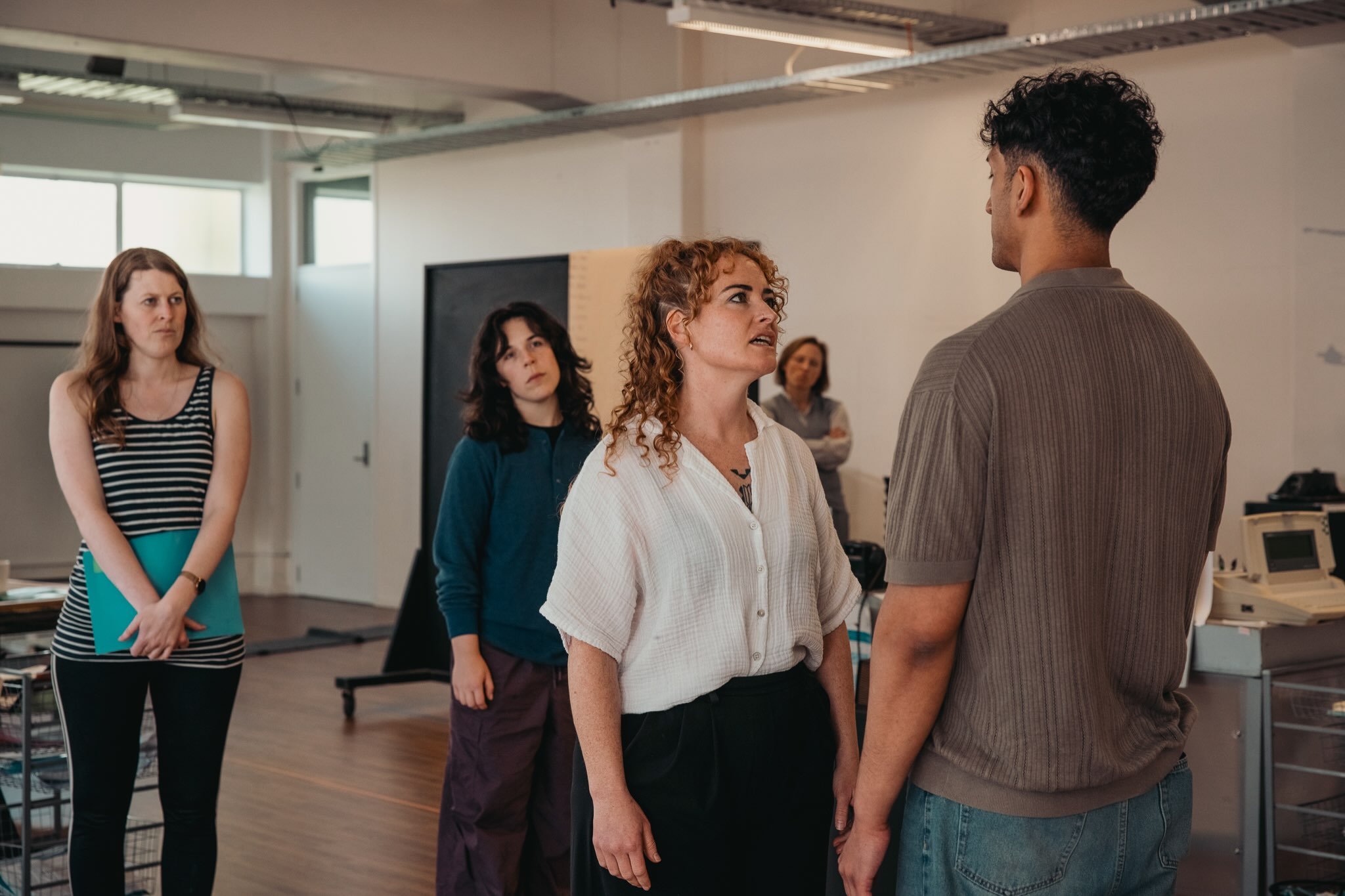
Photo credit: Belinda Bradley
Beth Alexander’s performance as Meg is palpable, opening the play with a visceral display of how pure fury can manifest itself inside of a person. As an unwilling new recruit, Meg is the reluctant hero of this tragedy, facing a bizarre opportunity with logical reservation. Her background immediately places her in a position of suspicion, eventually developing into a walking contradiction. Alexander staunchly holds this contradiction within Meg as a character who, ironically, is reacting to the situation the most realistically, by questioning the validity of the organisation that hands down ‘blind’ justice. Her hero's journey is painful, and Alexander shows this in her physicality and skilful interpretation of Meg’s dialogue.
Sheena Irving’s Maude has a delicious gravitas, set up to be the narrative’s ‘femme lady boss’ (think Dame Judy Dench’s M), with a depth of character that is tantalising from her first introduction. Maude holds the most solo stage time, and these scenes reveal millennia of experience and wisdom; Irving is careful to show us that Maude has seen every iteration of the inevitable cycle of human existence, and knows the ugly extent of which we are capable.
This play’s content is exceptionally substantial while keeping the pace of the show engaging. Director Harriet Maire has led a sensational ensemble cast of nine, and is able to display each actor utilised to their fullest. These characters and their stories contain depth which warrants further exploration; however, the play simply lifts the lid off the box that contains the Department of Fury and allows it to organically unfold. You are left wanting more, but not unsatisfied.

Photo credit: Belinda Bradley
Cherie Moore is electric as the organisation’s enforcer Maevis, with a stage presence that leaves the audience on tenterhooks, questioning what this somewhat more traditional rendition of a Furie will say, or do, next. Moore’s physicality and vocal strength opposite Irving do not set these two women of fury at odds; they are a team after all, and the chemistry between these two actors on stage deepens the sense of depth that is such a strength in this script.
Alice Pearce not only writes, but performs as middle-management Furie ‘Min. Pearce’s performance is a masterclass of serious comedy; it is very easy for the ‘office manager type’ to be caricatured as annoying or evil, but Pearce’s Min is an authentic portrait of an overworked administrator. Pearce delivers many a satirical nod to both ancient myth and contemporary social issues, in a way which does not limit the character to one dimension and allows the audience to understand the great value of her role in the organisation - it is crucial - the files never lie.
The Department’s unwavering faith in the facts of the files is a clever reflection of modern justice systems, trusting in the evidence laid out before us. Commentary on the nature of justice and law systems of New Zealand states that it is far from perfect, and the role of the Department is to bring retribution upon those who slip through the cracks. The most satisfying, and heartbreaking, conclusion of this discussion within the play is one of accountability - who is truly accountable when a mistake is made?
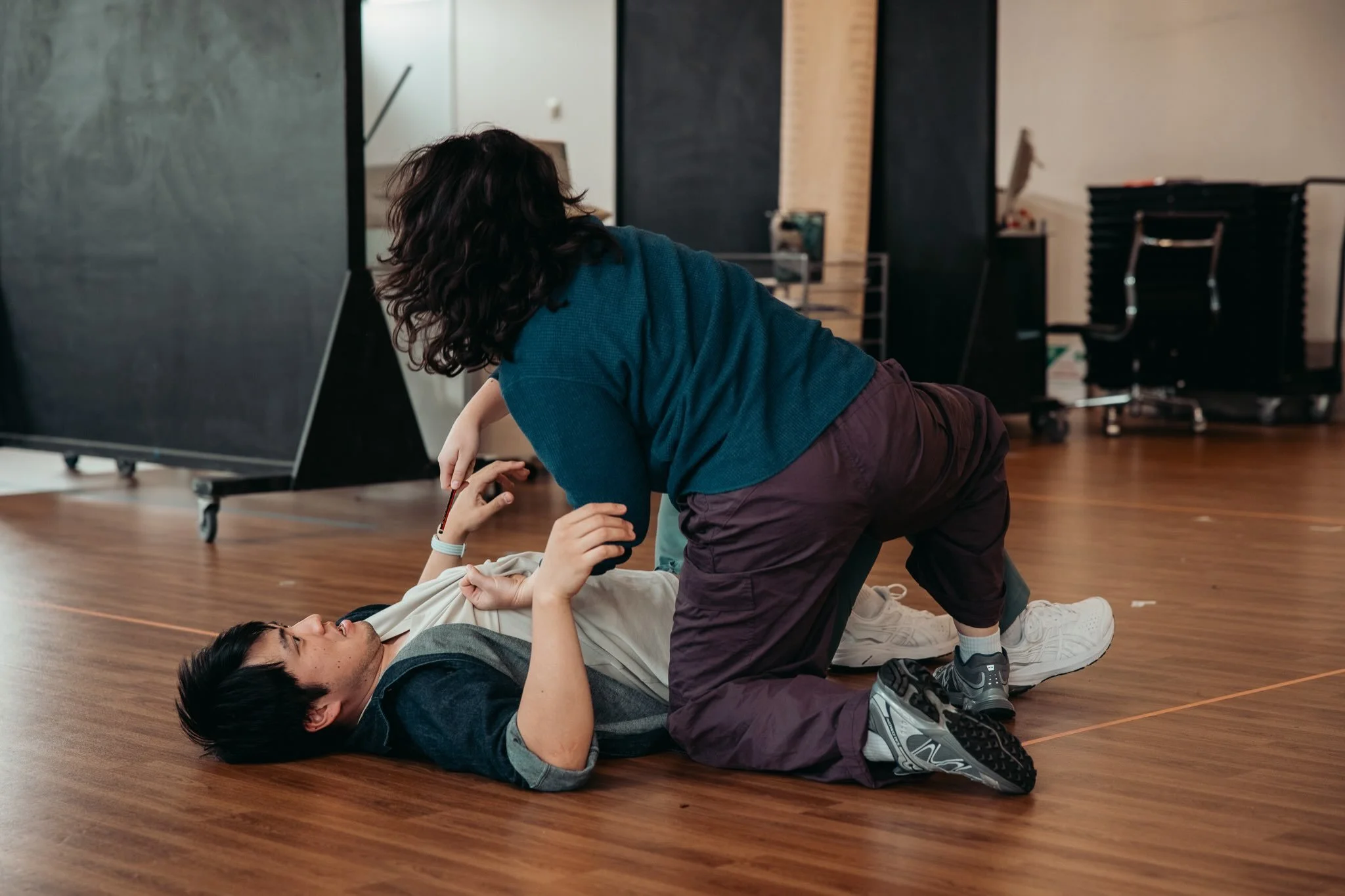
Photo credit: Belinda Bradley
Meg is joined by two other new recruits, Vena-Rose Lenanne’s Mahalia and Emma Campbell’s Mabel; the ancient Greeks had a penchant for grouping their legendary forces of nature into threes, and the organisation still follows that noble tradition. Lenanne’s Mahalia is a fervent recruit, showing excellent form in the stubbornness of her character; Lenanne gradually exposes Mahalia’s past traumas, working against the narrative veneer she has built around herself until it falls away in bursts of unrestrained fury.
Campbell’s Mabel is introduced as a less-than-typical recruit, her rage pushed down with conditioned guilt for taking up space in the world. Campbell beautifully shows Mabel’s feminine rage reaching its dangerous boiling point, with frenzied monologues that build and build until you want to see her truly explode - often played to delightful comic effect. Mabel is a character many femme audience members will strongly relate to, and Campbell’s performance of a ‘soft yet strong’ Furie is as invigorating as it is inspiring.
Ma’aola Faasavala steals moments in every scene she appears in as Marjorie; a comic relief role that is grounded heavily in the office setting of the play. Marjorie is introduced as the less-than-efficient fool, and plays ‘The Foil’ against Pearce’s ‘Wise Guy’ with spectacular results. Yet right from the audience’s introduction to Marjorie, there is a sense of something lurking in the shadows, an insidious past to be revealed as this story progresses.

Photo credit: Belinda Bradley
Dennis Zhang’s George is a tarnished pawn in the strategy game the Department of Fury are playing with the outside world, and Zhang’s performance, moving swiftly from disparaging confidence to panicked horror, beautifully depicts a man who is not ready to meet his own downfall. Dylan Thuraisingham’s Dave is an atypical antagonist to Alexander’s Meg; their conflict is situational rather than personal, born of circumstance instead of competing motivations. A perfect foil to the play’s central premise, Thuraisingham brings exceptional vocal precision to the role, creating a character who initially appears arrogant but gradually reveals himself to be among the drama’s most reasonable presences. By refusing to soften Dave’s anger, Thuraisingham ensures the audience understands that his outrage is not only genuine, but warranted.
This cast is housed within Chye-Ling Huang’s spectacular set design, a chaotic office landscape overflowing with paperwork and moving set pieces. Huang subtly incorporates elements of Greek architecture without ever compromising the play’s contemporary setting, while the constantly shifting scenery becomes a physical manifestation of a department desperately trying to impose order on chaos.
Lighting Design by Alylai Flynn is precise and incredibly effective in conveying emotional shifts and rising tension as the play progresses. In sequences centred on Meg as the office swirls with frantic activity around her, their use of light and shadow takes on an almost cinematic quality, placing the audience directly inside her experience of the chaos.
Connor Cully’s sound design is deeply emotive, steadily amplifying the sense of frenzy as the play hurtles towards its climax. There were moments in the Opening Night performance where the volume of certain sound design elements felt as if they needed to be adjusted, as they overwhelmed the dialogue of the scene in a distracting way; however, if the intention is ambience, then Cully has hit the mark stylistically.
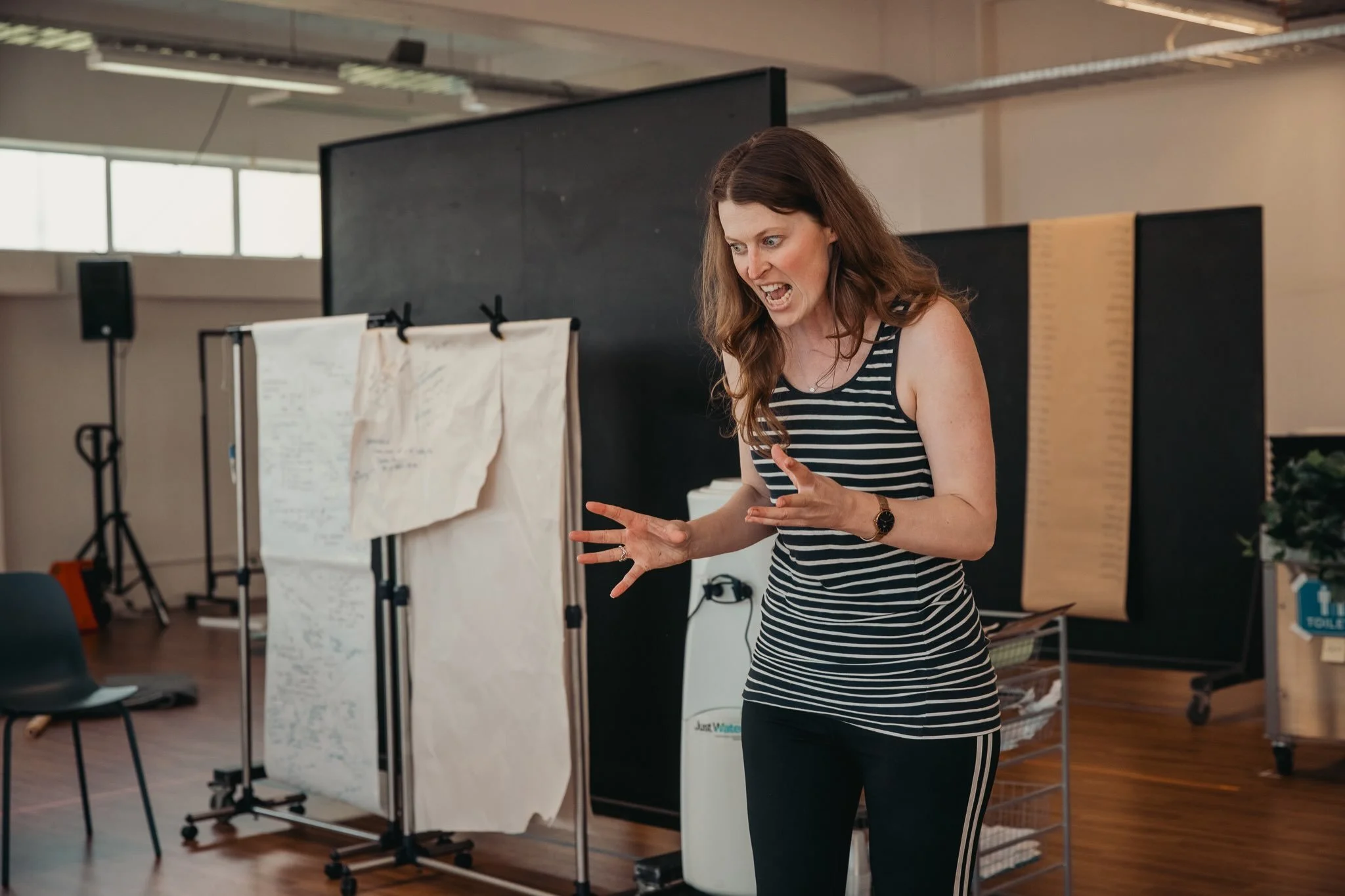
Photo credit: Belinda Bradley
Standout performances from this cast include fight sequences, with the team collaborating with Stunt Consultant Benjamin ‘Red’ Forrester to provide some truly knockout stage fighting that feels incredibly cathartic for the characters throwing the punches. Movement Support from Katrina George has produced exceptionally choreographed movement sequences throughout the play. Maire and George have directed these furies to flock together, often circling a target like vultures in a delicate dance waiting to strike their prey. Several sequences group the full Department of Fury together in an exhilarating assembly of their collective power, moving in unison to follow their prey with confident strides at their own menacing pace.
At its essence, this contemporary reimagining of ancient forces sits comfortably in the time and place. A Kind of Fury reminds the audience that injustice is rife, and that furious women are still deemed abrasive or dramatic, and a woman's fury still draws the bias of misogyny. Environmental damage and technological apprehension sit alongside biblical acts of patricide and corporal punishment. When these contemporary and ancient attitudes collide, the question of accountability rises alongside the bubbling tensions the press on the edges of the play, reaching a cathartic and heartbreaking conclusion.
The audience understands that these immortal beings have not been ripped from the age of mythology and thrust into our modern world - they have lived it, breathed it, been a part of its formation. Secrecy is paramount, but rest assured they have always been here, and likely always will be.
Content advisory: Contains mentions and depictions of violence, swearing, and depictions of blood.
A Kind of Fury is being performed at Auckland’s Q Theatre from 17 - 21 Nov 2026. Purchase tickets here
Review written by Charlie Underhill
