Sons of Vao
Presented by the Auckland Theatre Company
What does it mean to forgive? Spanning four decades, from village life in Niue in the 1970s to the suburbs of Ponsonby, this award-winning play follows the three brothers’ struggle to break free from their father.
Sons of Vao arrives on the Auckland Theatre Company stage with the weight of history, memory, and inherited pain, yet it pulses with humour, warmth, and a fierce Pasifika heartbeat. Written by Vela Manusaute and co‑directed with Anapela Polata’ivao, this world premiere is both deeply personal and culturally significant. It marks the first Niuean story presented by ATC, and it lands with the force of something long overdue.
At its core, Sons of Vao asks a deceptively simple question: what does it mean to forgive? The play spans four decades, moving from village life in Niue in the 1970s to the shifting streets of Ponsonby as the brothers grow into adulthood. But the real terrain is not geographic. It is emotional. It is the volatile, unpredictable shadow cast by their father, Vao.
Vao, played with precision by Beulah Koale, is the gravitational centre of the play. Charismatic, handsome, funny, ambitious. A man who can light up a room with charm, then extinguish that light in an instant. His sons worship him, fear him, and learn from him in ways they do not fully understand until adulthood. Violence is his language. Control is his comfort. His love is real, but it is warped by the tools he inherited and never questioned.
The staging captures this brilliantly. The set features a circular recess carved into a square stage. Vao remains inside this circle for almost the entire production. It becomes his domain, his trap, his legacy. His beer bottle, his belt, the objects that carry his rage, all sit within that boundary. The sons orbit around him, navigating the square stage as they recreate scenes from their childhood. The visual metaphor is clear without ever being heavy-handed. Vao is both the centre of their world and the cage they must learn to escape.
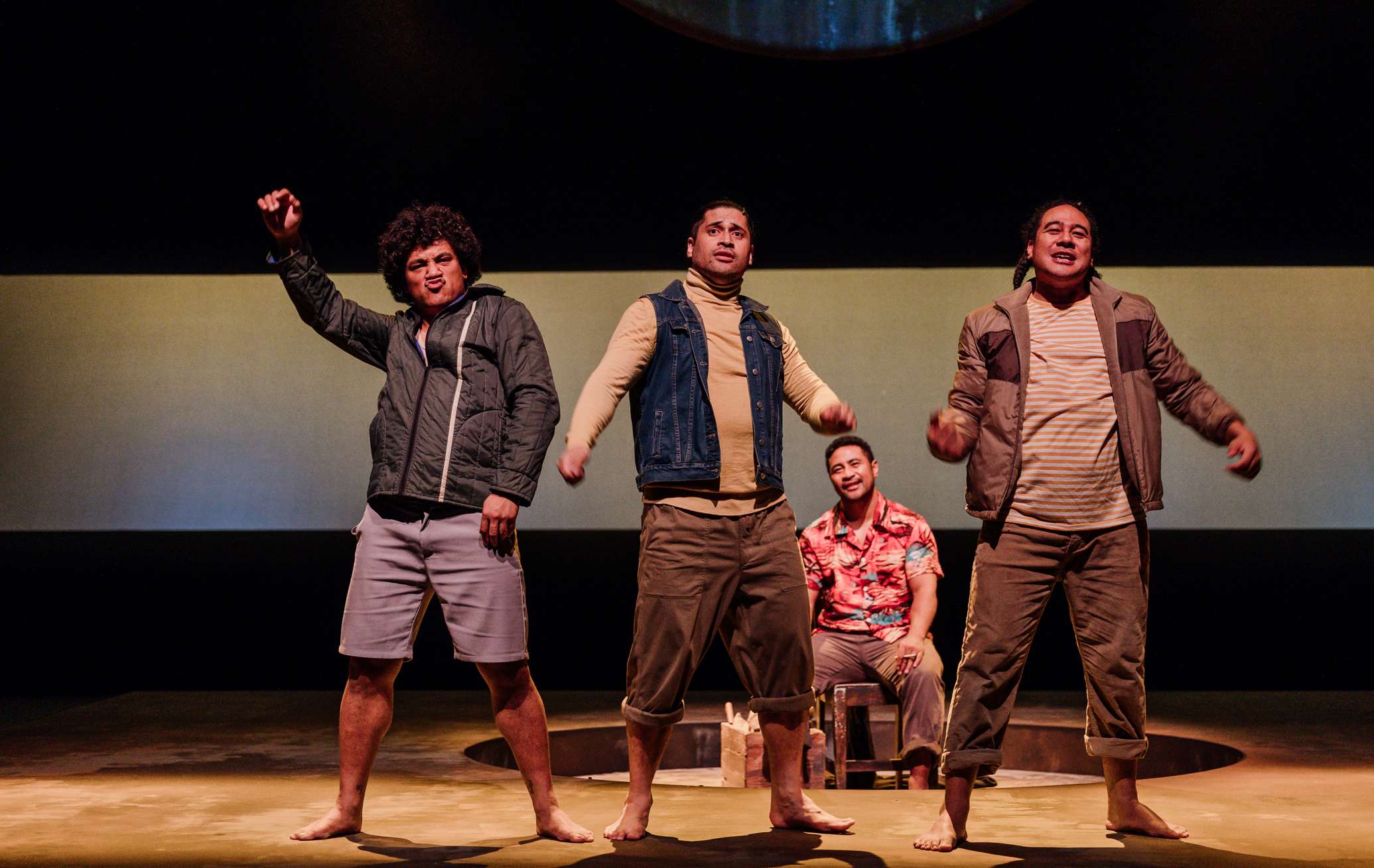
Photo credit: Andi Crown
The three sons, played by Haanz Fa’avae‑Jackson, Epine Bob Savea, and Brett Taefu, move through the story with a raw honesty that may sometimes feel performative, but never inauthentic. They shift between childhood and adulthood with ease, sometimes laughing at memories that should not be funny, sometimes breaking open under the weight of moments they have carried for decades. The play allows them to be messy, contradictory, and human. Each son is shaped by Vao in different ways, and the production honours those differences rather than flattening them into a single narrative of trauma.
What makes the play so compelling is how specific it is. The scenes feel like memories pulled straight from someone’s mind, complete with details that do not necessarily advance the plot but deepen the world. A joke told at the wrong time. A moment of tenderness quickly shut down. A sibling rivalry that masks fear. These fragments accumulate into something textured and lived‑in. You can feel that this story comes from somewhere real.
Manusaute’s script is autobiographical, and that truth sits just beneath the surface. It took years and much support for forgiveness to become possible. Sons of Vao is the result of that long journey.
The production does not shy away from the violence, but it also refuses to sensationalise it. Instead, it examines the systems that create men like Vao. Migration. Displacement. Masculinity shaped by hardship. The pressure to provide. The inability to express softness. The play understands that violence does not appear out of nowhere. It is taught, inherited, and normalised. And if it is learned, it can be unlearned, though not without immense effort.
Despite the heaviness of the subject matter, the play is surprisingly funny. Pasifika humour threads through the script, offering relief without undermining the seriousness of the story. The brothers tease each other. They mimic their father. They laugh at their own pain because sometimes that is the only way to survive it. The humour never feels out of place. It feels like truth.
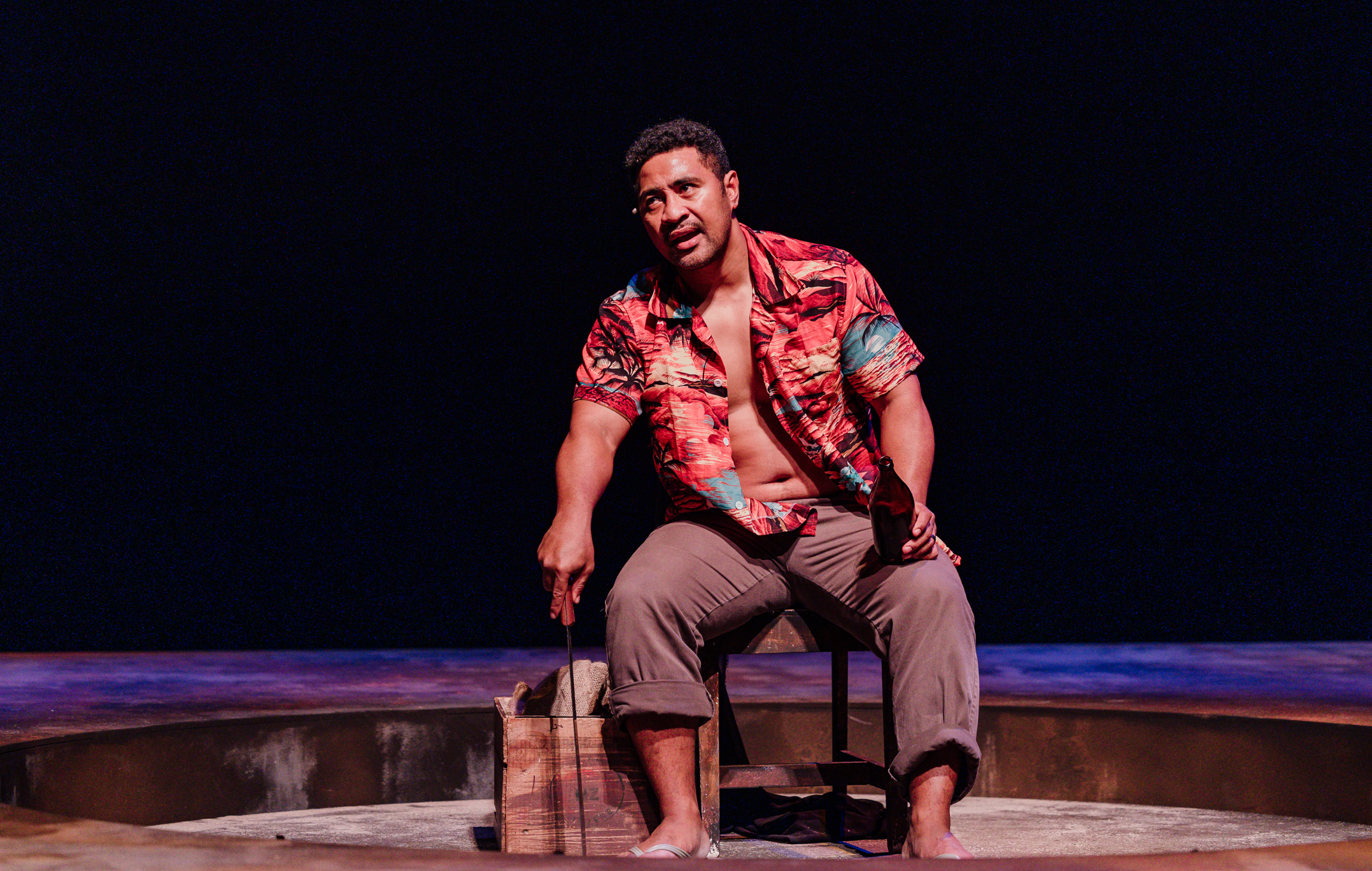
Photo credit: Andi Crown
Polata’ivao’s direction is masterful. She balances the emotional intensity with moments of stillness, allowing the audience to breathe. She understands the cultural nuances, the rhythms of Pasifika storytelling, the importance of community and family. Her touch is evident in the pacing, the physicality, the way silence is used as powerfully as dialogue.
The design team supports this vision beautifully. The production design by Sean Coyle creates a space that feels both symbolic and grounded. The sound design by Sam Clavis and composition by David Long weave atmosphere through the scenes without overwhelming them. The dramaturgy by Stacey Leilua ensures the story remains sharp and coherent, even as it moves across decades. Every element works in harmony.
What lingers most is the emotional complexity. This is not a simple story of a violent father and damaged sons. It is a story about love twisted by circumstance. About the ways children learn to survive. About the long shadow of masculinity. About the possibility of healing even when the person who hurt you is gone. The play does not offer easy answers. It does not pretend forgiveness is simple. It shows that forgiveness is a choice made again and again, not for the person who caused the harm, but for the person who carries it.
The final scenes are devastating in their simplicity. The sons stand on the edge of their father’s circle, no longer trapped by it but still shaped by it. The past remains, but it no longer defines them. The play ends not with triumph, but with understanding. And that understanding feels like a kind of freedom.
Sons of Vao is a landmark production. Raw, emotional, and unexpectedly tender, it is a love letter written in bruises and healing. It is a story that honours Niuean identity, Pasifika resilience, and the complicated bonds between fathers and sons. It is theatre that stays with you long after the lights come up.
Performances run from 18 Jun – 5 Jul 2026 at the ASB Waterfront Theatre. Purchase tickets here.
Review written by Alex Moulton
