Cagnat, Drawing or Nothing (Cagnat, le dessin sinon rien) (2024)
Screening as part of Doc Edge 2026
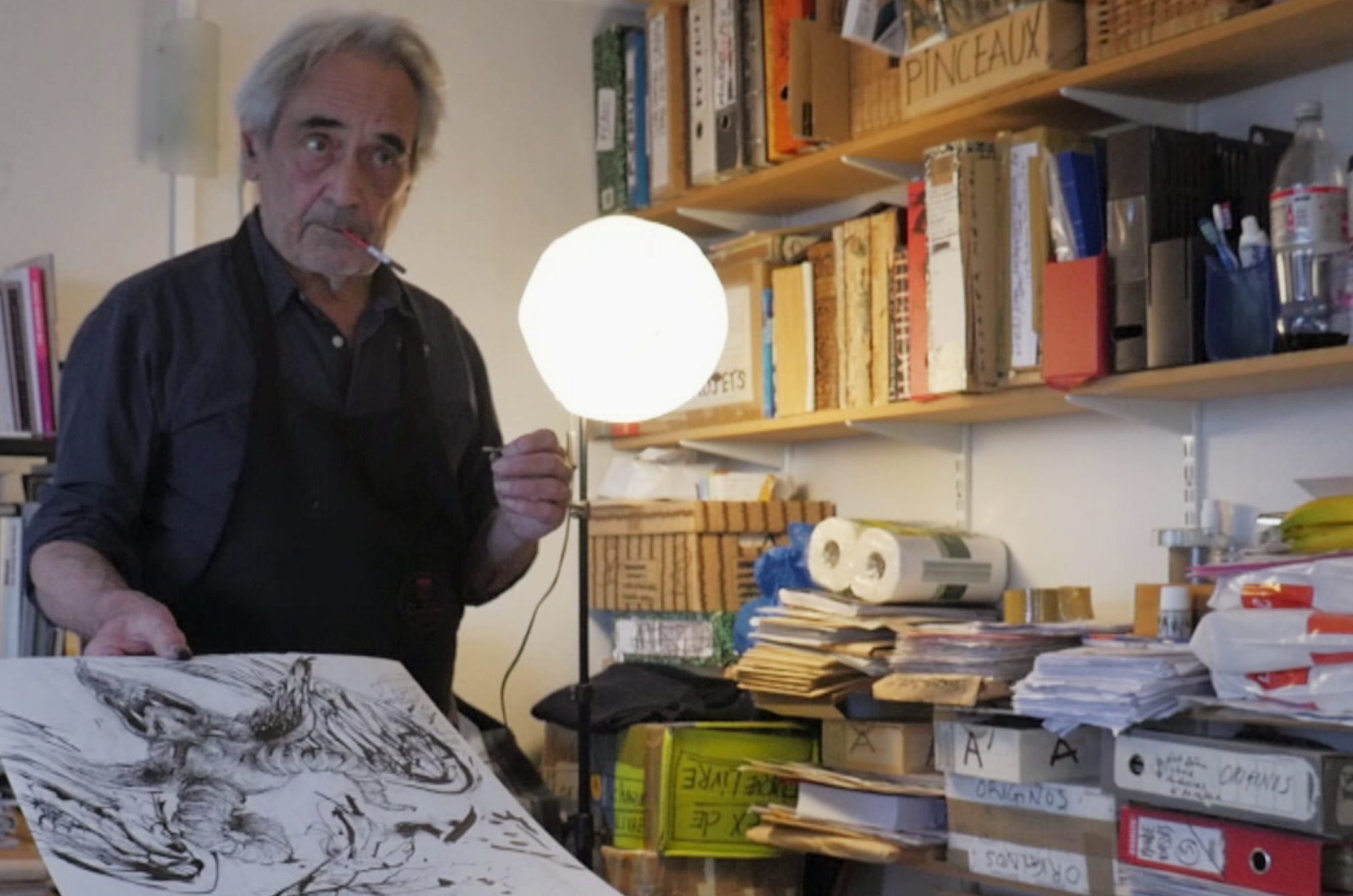
Since the Charlie Hebdo attack, Jean-Pierre Cagnat, a press cartoonist, no longer draws. The National Library of France offered to archive part of his work. After his divorce from his wife, he left his 17,000 drawings in the cellar of his family home, which he no longer lives in. His daughter, Director Alice Cagnat, proposed an arrangement: she would help him sort through his drawings, in exchange for his life story as a man and an artist.
Cagnat, Drawing or Nothing is a deceptively simple documentary that opens with boxes in a cellar and ends with something far more delicate: a daughter trying to understand the father she never fully knew. Directed by Alice Cagnat, the film follows her attempt to help her father, Jean‑Pierre Cagnat, sort through the 17,000 drawings he abandoned after the 2015 Charlie Hebdo attack. What begins as an archival task becomes a psychological excavation, a family reckoning, and a portrait of an artist whose silence has become heavier than his life’s work.
Jean‑Pierre Cagnat is not the kind of political cartoonist people imagine when they think of ideological warriors. He was never a militant, never a party loyalist, never a man chasing revolution. He was, instead, a classic French bohemian. A non‑conformist. A man who rebelled not through manifestos but through ink. His loyalty was to freedom of expression, to the right to mock the powerful, to the tradition of satirical irreverence that shaped publications like Le Canard Enchaîné and Le Monde. His drawings were sharp, witty, and deeply observant. They skewered politicians across the spectrum, not out of hatred, but out of a belief that authority should never go unchallenged.
The documentary makes it clear that Cagnat’s rebellion was personal, not ideological. He rejected institutions, not because he wanted to replace them, but because he refused to be shaped by them. His art was his independence. His line work was his voice. And when the Charlie Hebdo attack occurred, that voice collapsed. The attack, carried out by individuals affiliated with al‑Qaeda in the Arabian Peninsula, devastated the French cartooning community. Cagnat was not part of the Charlie Hebdo staff, but the trauma hit him with full force. He stopped drawing entirely. Not as a political statement, but as a response to grief, fear, and a sense that the world he had spent decades lampooning had become too violent to face.
The film begins ten years after that silence began. His drawings sit untouched in the cellar of the family home he left after his divorce. Alice proposes a deal: she will help him select 4,000 drawings for the National Library of France, but in exchange, he must finally tell her who he was. Not the cartoonist in the newspapers. Not the eccentric figure people admired from afar. The man. The father. The person behind the ink.
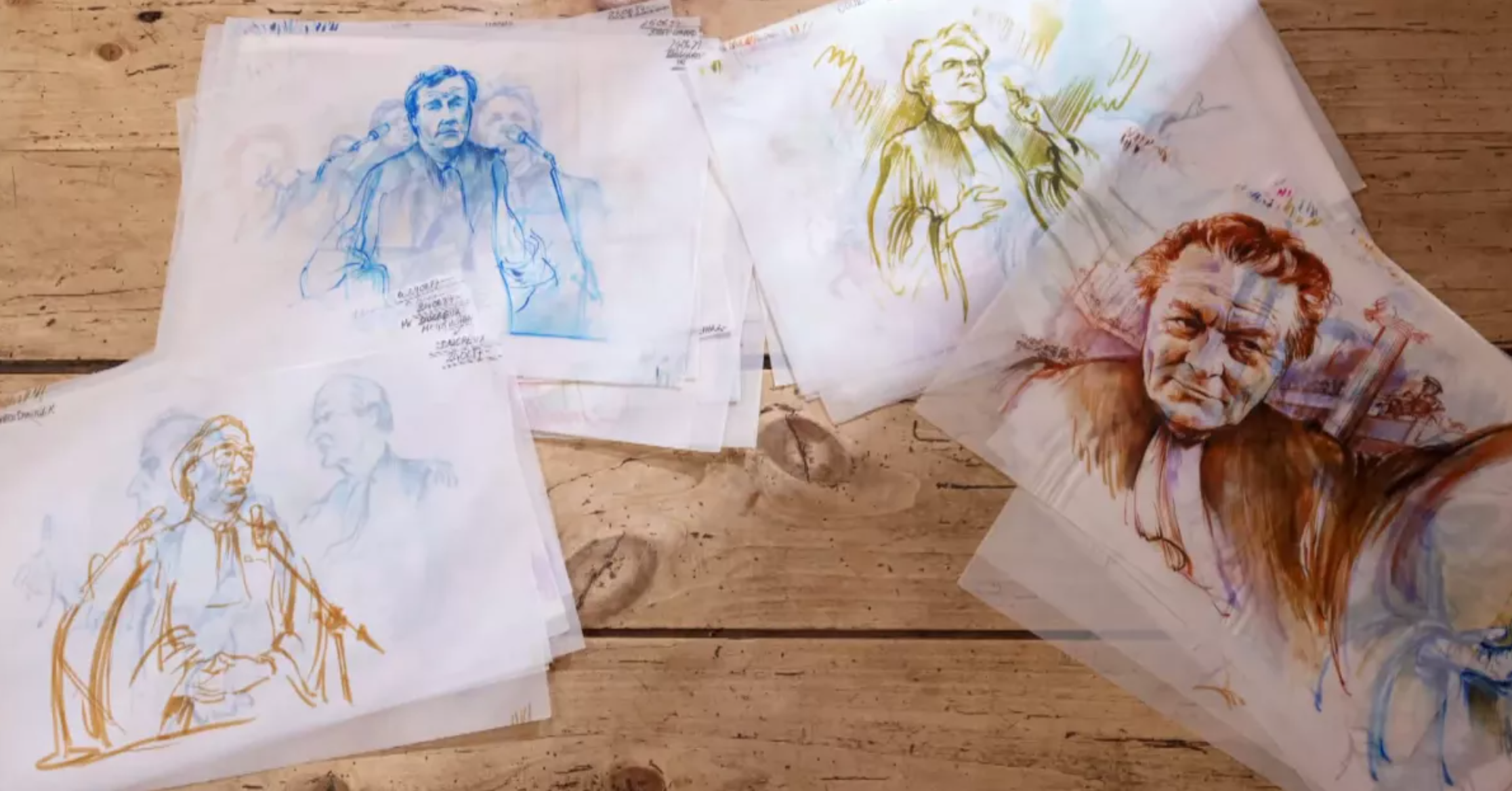
This deal becomes the spine of the documentary. Each box opened is a prompt. Each drawing pulled from the pile is a doorway into a memory. Alice admits early on that she grew up with little understanding of the scale of her father’s work. She knew he drew. She knew he was published. But she did not know the breadth of his career, the global events he captured, the courtroom sketches he produced during the Klaus Barbie war crimes trial, or the sheer volume of political satire he created for decades. The film becomes her education, and ours.
The drawings themselves are extraordinary. Cagnat’s style is unmistakable. Clean, elegant lines. Indian ink that slices across the page with confidence. Watercolour and acrylic washes that add vibrancy without overwhelming the composition. His caricatures exaggerate without cruelty. His portraits reveal eccentricities with affection. His work is playful, sharp, and deeply human. He could capture the essence of a person in a few strokes, isolating the quirks that define them. His illustrations of Sherlock Holmes enthusiasts, his grotesques, his political figures, all reveal an artist fascinated by the oddities of human behaviour.
Yet the film is not an art retrospective. It is a psychological study. A portrait of a man who severed himself from his identity and has been drifting ever since. The cellar becomes a metaphor for his mind. Dark. Cluttered. Full of ghosts. Alice’s presence becomes the light that forces him to confront what he abandoned.
The documentary is quiet, almost claustrophobic. Cagnat does not open up easily. He answers questions indirectly. He deflects. He jokes. He avoids. The narrative feels restrictive at times, because he is restrictive. He is a man who has lived inside his own head for too long. But the camera catches something subtle. As he handles the drawings, as he studies his own line work, something shifts. His fingers remember the movements. His eyes follow the curves of ink. The creative impulse, dormant for a decade, begins to stir.
The film documents this thawing with patience. It does not rush him. It does not force a breakthrough. Instead, it watches as the act of sorting becomes an act of healing. For a man who abandoned his identity, looking at his own drawings is not nostalgia. It is reawakening. The documentary captures the moment he picks up a pen again. It is small, almost unremarkable, but it carries the weight of a man reclaiming a part of himself he thought was gone forever.
The father‑daughter dynamic is the emotional core of the film. Alice is gentle but persistent. She wants answers. She wants stories. She wants to understand the man who raised her. Cagnat resists, not out of malice, but out of habit. He has spent his life observing others, not revealing himself. The documentary becomes a negotiation between silence and disclosure. Between the desire to know and the fear of being known.
Yet for all its depth, the documentary remains simple in structure. Boxes. Drawings. Conversations. A cellar. A pencil. It does not need more. The simplicity allows the emotional complexity to surface naturally. It allows the audience to sit with the tension between past and present, between silence and expression.
If anything, the film leaves you wanting more stories. More context. More insight into the pieces that flash across the screen. But perhaps that is intentional. Cagnat is not a man who gives everything away. He reveals only what he chooses. The rest remains in the boxes.
In the end, Cagnat, Drawing or Nothing is a film about creative paralysis, family secrets, and the slow, fragile process of returning to oneself. It is about a daughter trying to understand her father, and a father trying to remember who he was. It is quiet, intimate, and unexpectedly hopeful. A portrait of a man who stopped drawing, and the moment he begins again.
Screening as part of Doc Edge 2026. Check out the films and screenings here
Review written by Alex Moulton
