Loving Karma (2025)
Screening as part of Doc Edge 2026
In the remote foothills of the Himalayas, former monk Lobsang Phuntsok founded Jhamtse Gatsal, a refuge for children shaped by abandonment and trauma. Once a teacher in the United States of America, he returned to India to build the community he never had as an orphan. Tashi, the youngest and most volatile arrival, carries the scars of a fractured childhood and resists every attempt at care. Twelve years after the Emmy Award winning Tashi and the Monk, this film follows their lives and a new generation of children, revealing a community where healing emerges through shared responsibility, presence, and love.
There is a quiet stillness to the Himalayan foothills that feels almost unreal, a landscape where clouds drift low and the world seems to move at a slower, more deliberate pace. Into this setting returns Loving Karma, a documentary that revisits the children’s community of Jhamtse Gatsal more than a decade after the filmmakers first captured its story. What emerges is not a simple sequel, but a layered portrait of growth, grief, and the fragile work of healing.
The film centres again on Lobsang Phuntsok, a former Buddhist monk who built Jhamtse Gatsal as a refuge for children who had nowhere else to go. His own childhood was marked by abandonment, and the community he created is both a response to that pain and an attempt to rewrite the narrative for others. The documentary does not shy away from the contradictions in his character. He is compassionate, patient, and deeply committed, yet also burdened by guilt, stretched thin by responsibility, and haunted by the children he could not save.
The emotional anchor of the film is Tashi, the fiery four‑year‑old from the Emmy‑winning Tashi and the Monk. In the early footage, she is a storm of anger and confusion, lashing out at classmates, threatening her stuffed toys, and testing every boundary placed in front of her. The filmmakers capture these moments with a natural intimacy that avoids sensationalism. Tashi is not framed as a problem child, but as a child shaped by trauma, trying to make sense of a world that has not been kind to her.
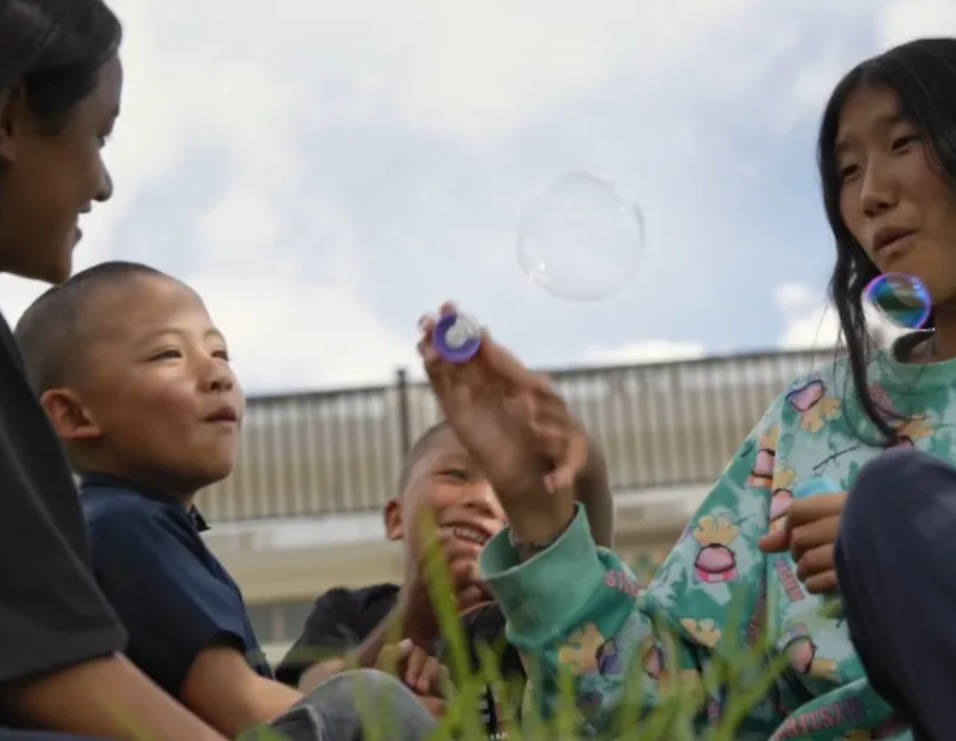
Then the film leaps forward twelve years. Tashi is now sixteen, taller, steadier, and carrying herself with a maturity that feels hard‑won. She has become a big sister to two new arrivals, both young children named Karma, each with their own histories of neglect. Watching Tashi guide them is one of the film’s most moving threads. She rolls vegetables into rotis so they can eat more easily. She tucks them under her blanket when they complain of the cold. She teaches them how to play, how to share, how to trust. The transformation is not presented as a miracle, but as the slow, cumulative result of being loved consistently.
The filmmakers, Andrew Hinton and Johnny Burke, approach their subjects with a sensitivity that feels earned. They have spent years with this community, and that familiarity allows them to capture moments that feel unguarded. A child crying after being gently redirected. A teenager laughing with friends. A quiet conversation between Lobsang and an elder. These scenes are not staged. They are lived.
What sets Loving Karma apart from other documentaries about children’s homes is its refusal to romanticise hardship. The film shows the beauty of Jhamtse Gatsal, but it also shows the strain. There are not enough resources to take in every child who needs help. Some families arrive desperate, hoping to leave their children in Lobsang’s care, and when they are turned away, anger follows. In one instance, a mob from a nearby village confronts the community, furious that one of their own was rejected. The film does not sensationalise this conflict, but it does not hide it either. It is a reminder that compassion alone cannot solve systemic poverty.
One of the most painful moments comes when Lobsang reflects on a child he could not accept, who later died by suicide. The guilt is palpable. He questions his decisions, his limitations, and the weight of being seen as a saviour. The documentary handles this with care, acknowledging the tragedy without exploiting it. It becomes a turning point, revealing the emotional cost of running a community built on love.
Yet the film is not bleak. It is filled with small acts of tenderness that accumulate into something profound. A boy offering an apple to the mother who once neglected him. A girl helping a younger child wash his face. A group of children gathering garlic and chillies from a field to bring to the school kitchen. These gestures are simple, but they carry the weight of transformation. The film suggests that healing is not found in grand gestures, but in daily acts of care.
The cinematography mirrors this philosophy. The camera lingers on hands, on faces, on the texture of the landscape. The mountains are not just a backdrop. They are a presence, a reminder of isolation and resilience. The sound design is equally subtle. Wind through trees. Children’s laughter. The soft murmur of prayer. Nothing is overstated.
The film also raises questions about the future. Will these children grow into independent adults, or will they remain tethered to the community that raised them? Can love alone prepare them for a world that may not be as gentle? The documentary does not offer answers. Instead, it allows the uncertainty to sit alongside the hope.
One of the most striking aspects of Loving Karma is its portrayal of community as a living organism. The children are not passive recipients of care. They are active participants in each other’s healing. Older children teach younger ones how to read, how to forage, how to navigate conflict. They form bonds that resemble siblinghood more than friendship. The film captures this with a warmth that feels genuine rather than sentimental.
There is also a sense of continuity that gives the documentary its emotional depth. Seeing Tashi as a teenager after meeting her as a child provides a rare longitudinal perspective. Short films can capture a moment, but they cannot show growth. Loving Karma does. It shows how time reshapes people, how wounds soften, how anger becomes responsibility.
The film is not perfect. Some viewers may question the sustainability of Lobsang’s model. Others may wonder whether the children’s dependence on the community will hinder their independence later in life. The documentary acknowledges these concerns without dwelling on them. It is more interested in the present than in hypothetical futures.
By the end, what lingers is not the hardship, but the humanity. The film suggests that love is not an abstract ideal. It is a practice. A discipline. A choice made every day. It is found in shared meals, in bedtime routines, in the act of holding space for someone else’s pain.
Loving Karma is a gentle, honest, and deeply human documentary. It does not offer easy answers, but it offers something better: a portrait of a community trying, failing, learning, and trying again. It is a reminder that healing is messy, that compassion is imperfect, and that even the smallest acts of kindness can change the course of a life.
Screening as part of Doc Edge 2026. Check out the films and screenings here
Review written by Alex Moulton
