Churr My Neighbour

Craig White is excellent at his job, unfortunately he is also a massive piece of shit. After transforming Christchurch’s most unsellable suburbs, Craig has relocated to Auckland and is ready to sell any suburb, subdivision, or neighbourhood at any price.
Churr My Neighbour is a loud, cheeky and surprisingly heartfelt solo performance that blends satire, character work and community storytelling into a fast-moving hour of theatre. Written and performed by TJ Snow and directed by Sean Dioneda Rivera, the show takes aim at real estate culture, suburb stereotypes and the messy pride that comes with growing up in a neighbourhood people love to judge. It is energetic, chaotic, and built entirely around Snow’s ability to transform himself into a parade of characters with nothing more than voice, posture and attitude.
The setup is simple but effective. The audience enters a long, narrow playing space that stretches from the theatre door to the back wall. Along one side sits the crowd, and along the other stands a row of corrugated metal fencing sheets covered in graffiti. The floor is astroturf. A small treadmill sits in the centre. A trolley with a crate and an old CRT television waits off to the side. The space feels like a backyard, a street corner, a forgotten alley and a makeshift film set all at once. It is a clever design choice that allows Snow to shift scenes without ever needing to move a prop.
Before the show even begins, Snow is already in character. He greets every audience member with a handshake, remembers names he absolutely does not remember, and turns on the smarm of a real estate agent who thinks he can sell anything to anyone. The fitted suit, cropped pants, boat shoes and manbun complete the picture. He is a walking caricature of shallow confidence, and the pre-show interaction sets the tone for what follows. The audience is not just watching the show. They are part of the pitch.
The premise is simple. A high-end real estate agent attempts to sell Aranui, a Christchurch suburb that is often stereotyped, misunderstood or dismissed. Snow uses this setup as a springboard to introduce a range of characters from the neighbourhood. The cousins. The junkie. The single mother. The guy who knows everyone’s business. The person who has lived there forever and refuses to leave. Each character arrives quickly, sometimes with no transition at all, and Snow shifts between them with impressive clarity. He changes his voice, his stance, his rhythm, his diction and his moral compass. The distinctions are sharp enough that the audience never loses track of who is speaking.
The show relies heavily on audience participation. Snow asks questions, demands high-fives, throws out fist bumps, and occasionally pulls people into the action with no warning. He handles silence well, rolling with awkward pauses and unexpected answers. He also knows how to ride the wave of a loud laugher or a particularly enthusiastic participant. The interaction feels organic rather than forced, and it adds a sense of unpredictability that suits the show’s loose structure.
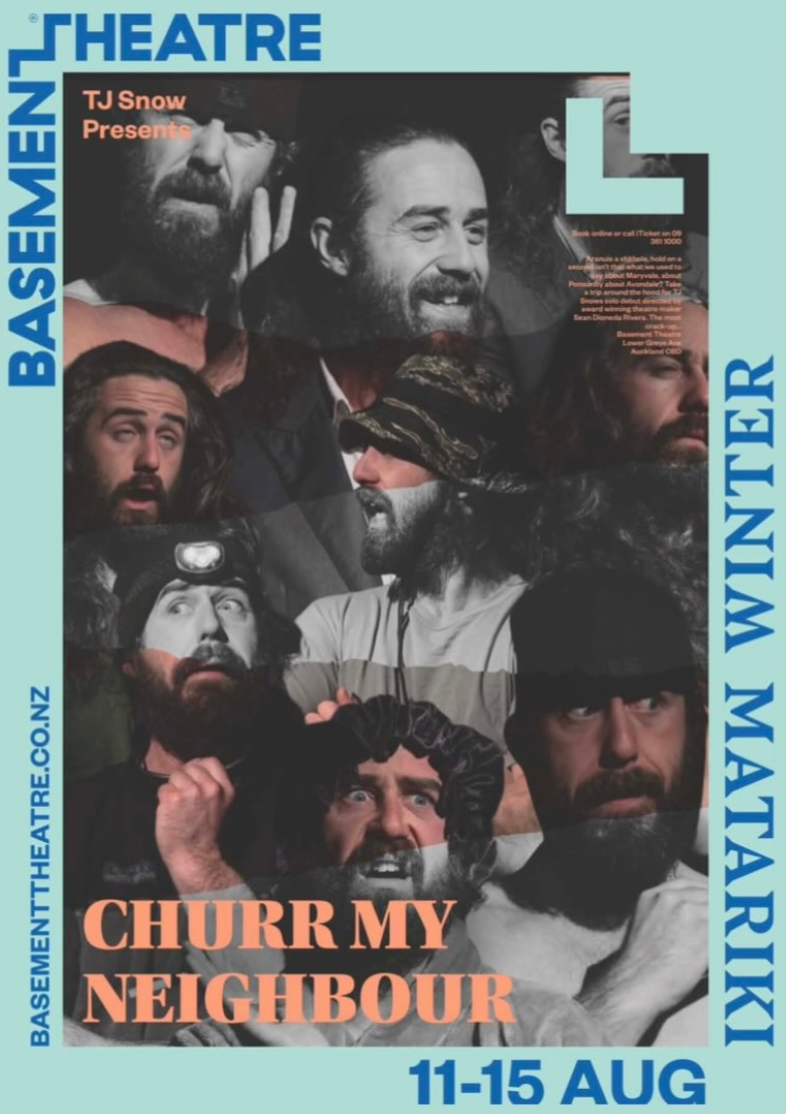
There is no traditional narrative. Churr My Neighbour is not a story with a beginning, middle and end. It is a collage of voices, a collection of moments, a portrait of a suburb built from fragments. Snow leans into this structure, allowing characters to wander off-topic, ramble, contradict themselves or reveal something personal without tying it back to a larger plot. This lack of narrative progression can affect pacing, but it also gives the show its charm. It feels like spending an hour with people you grew up around, people who talk in circles, people who tell stories that go nowhere but still matter.
Snow plays with stereotypes, but he does not leave them flat. He pushes aggression, frustration and racial tension to the edge, then pulls back to reveal something more human. The characters are exaggerated, but not hollow. Their stories carry pride, shame, humour and resilience. Snow transforms them from punchlines, using comedy to highlight the complexity of communities that are often reduced to headlines or jokes.
The treadmill becomes a recurring device. Snow uses it to shift energy, create physical comedy and mark transitions between characters. The minimalism forces Snow to rely entirely on performance rather than props, and he rises to the challenge.
The bilingual nature of the dialogue adds authenticity, though it occasionally makes lines harder to catch. For the most part, his delivery is clear, but there are moments where excitement and speed blur the words, especially when Snow faces away from the audience during mock-filming scenes. This does not detract significantly from the experience, but it is noticeable.
What stands out most is the show’s sense of place. Snow builds Aranui not through plot, but through people. The pride, cringe, humour, frustration and affection that come with living in a neighbourhood like this are all present. The show could be set in Aranui, Ranui, Manurewa, Otara or any number of suburbs across Aotearoa. The characters feel familiar because they are drawn from real communities, not stereotypes invented for comedy.
The performance is not polished in the traditional sense. It is rough, loud, messy and occasionally chaotic. But that is the point. Snow captures the energy of a neighbourhood that refuses to be tidy. He embraces the imperfections and uses them to build authenticity. The show is less about telling a story and more about celebrating a community that is often overlooked or misunderstood.
Churr My Neighbour is a strong debut solo work. Snow’s character work is sharp, his comedic instincts are quick, and his ability to hold an audience is impressive. The show is funny, heartfelt and full of personality. It is not a narrative-driven piece, but it is a vivid slice of life that will resonate with anyone who has grown up in a suburb with a reputation.
Churr My Neighbour is being performed on Tue 11 - Sat 15 Aug 2026 at Auckland’s Basement Theatre. Purchase tickets here
Review written by Alex Moulton
