Tony (2026)
From Director Matt Johnson, TONY is the electric origin story of food icon Anthony Bourdain. The film follows 19-year-old Tony (Dominic Sessa) as he travels to Provincetown and stumbles into the chaotic world of a restaurant kitchen, setting off a summer that will shape the course of his life.
Tony is a biographical drama that chooses intimacy over scale, focusing on one turbulent summer in the mid‑1970s rather than attempting to summarise Anthony Bourdain’s entire life. Director Matt Johnson approaches the material with a documentary‑style eye, creating a film that feels spontaneous, grounded and quietly chaotic. Instead of mythologising its subject, the film observes a young man who has not yet found his calling, stumbling through a period defined by insecurity, bravado and the first hints of adulthood.
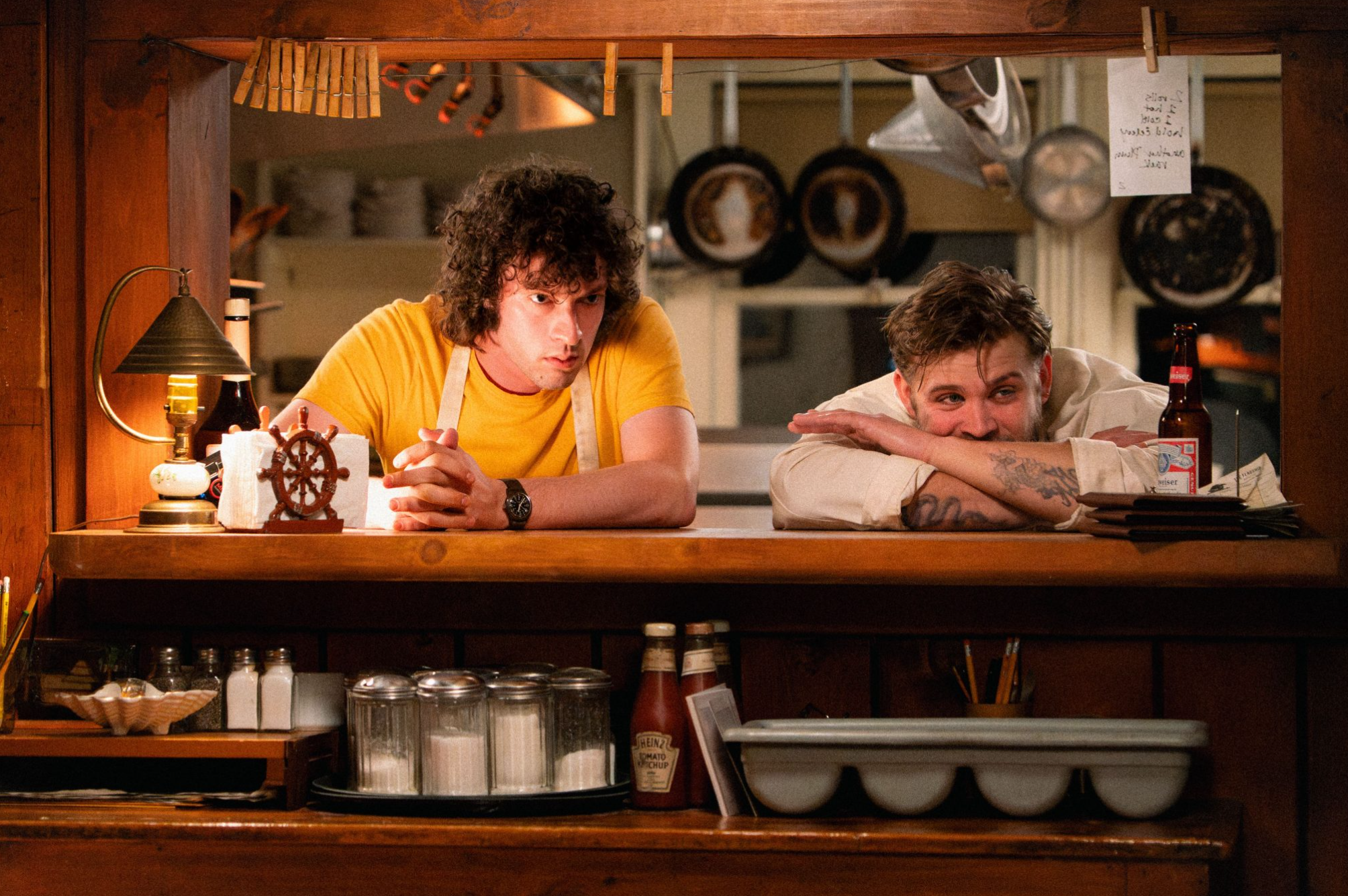
Johnson’s filmmaking style is the first thing that stands out. He shoots inside a real working kitchen, using long lenses and multiple cameras to capture the environment without staging or repetition. The actors move freely, the space remains unpredictable, and the camera reacts rather than directs. This gives the film a raw, observational quality. It avoids the polished, high‑energy editing associated with modern food dramas and instead embraces the natural rhythm of a kitchen as a place where craft, community and chaos coexist.
Dominic Sessa plays the young Bourdain with a mix of arrogance, charm and restless uncertainty. He is not portrayed as a prodigy or a misunderstood genius. He is a college student who believes he is destined for greatness, even though he has not yet earned it. The film opens with him applying for a prestigious writing fellowship, convinced he will receive it. When he does not, he spirals into a summer of impulsive decisions driven by pride and embarrassment. Sessa leans into the character’s flaws, making him compelling precisely because he is not always sympathetic.
The film’s early scenes capture the awkwardness of a young man who thinks confidence can replace experience. His trip to Cape Cod is fuelled by ego rather than planning, and the consequences arrive quickly. He has no place to stay, no money and no real understanding of the world he is stepping into. Johnson uses this discomfort to push the character into unfamiliar territory, forcing him to confront the limits of his own self‑image.
Antonio Banderas plays the unnamed chef who becomes a reluctant mentor. His performance is calm, grounded and quietly magnetic. He embodies a man who has seen enough to recognise both potential and danger in the young dishwasher who shows up on his porch. Banderas does not play the role as a wise sage or a stern disciplinarian. Instead, he offers a steady presence, someone who understands that kitchens are built on discipline, community and a willingness to learn. His rules are simple, and his expectations are clear. He forgives almost everything except lateness.
Leo Woodall’s Sal provides the counterbalance. He is volatile, charismatic and unpredictable, a reminder of how easily young men can be pulled toward self‑destruction. Woodall’s performance is electric, shifting between humour and menace with ease. He represents the version of Bourdain that could have existed if he had followed his worst impulses. The dynamic between Sal and the chef becomes the film’s emotional compass, showing the two paths that Bourdain will continue to wrestle with throughout his life.
Emilia Jones appears as Nancy, the older student who becomes the catalyst for Bourdain’s impulsive summer. Her role is intentionally limited, reflecting how young men often project fantasies onto people they barely know. She is not a romantic lead. She is a reminder that Bourdain’s early motivations were shaped more by ego than by genuine connection. The film does not idealise her or turn her into a moral anchor. Instead, she becomes part of the environment that forces Bourdain to confront his own immaturity.
Johnson’s decision to adapt only a few chapters of Kitchen Confidential gives the film a refreshing clarity. It avoids the biopic trap of racing through decades of milestones. Instead, it focuses on emotional truth rather than factual completeness. Characters are composites, timelines are compressed and details are adjusted for dramatic effect. This allows the film to explore the internal shifts that matter more than external achievements. It is not about what Bourdain accomplished. It is about how he began to understand himself.

The kitchen sequences are some of the strongest in the film. They are not frantic or stylised. They are sweaty, loud and full of small interactions that reveal the culture of the space. Johnson captures the camaraderie, the tension, the humour and the danger without turning the kitchen into a spectacle. Food is present, but it is not the focus. The film is more interested in the people who inhabit the kitchen than the dishes they produce.
The visual style leans heavily into a 1970s aesthetic. The colour palette is muted and warm, like an old photograph. Costumes and production design reinforce the period without drawing attention to themselves. The look of the film mirrors Bourdain’s emotional state: confused, restless and constantly on the edge of something he cannot yet define.
The film’s greatest strength is its honesty. It does not try to make Bourdain heroic. It does not try to explain his entire life. It does not try to justify his later choices. Instead, it shows a young man who is arrogant, insecure, selfish and full of potential. It shows how mentorship, friendship and failure shape him. It shows how easily he could have gone down a different path. It shows how the kitchen became a place where he learned discipline, community and craft.
Tony is a coming‑of‑age story that succeeds because it stays small. It does not chase spectacle or mythmaking. It focuses on one summer, one kitchen, one young man trying to figure out who he is. It is sincere, messy and full of humanity. It is a biopic that understands that the most important moments in a life are often the ones that happen before anyone is watching.
Tony releases in NZ cinemas on August 20. Find your nearest screening
Review written by Alex Moulton
