Power Ballad (2026)
When Rick (Paul Rudd), a past-his-prime wedding singer, meets fading boy-band star Danny (Nick Jonas) during a gig, the two bond over music and a late-night jam session. But when Danny turns one of Rick’s songs into the hit that reignites his career, Rick sets out to reclaim the recognition he believes he deserves - even if it means risking everything he cares about. From writer-director John Carney (Sing Street, Once), Power Ballad is a feel-good story about music, self-respect, friendship, and the price of ambition.
John Carney has carved out a niche as the filmmaker who understands musicians better than most. Not the stadium‑filling icons, but the everyday artists who carry a quiet ache for the life they almost had. Power Ballad fits neatly into that world. It is a warm, gently funny, and emotionally sincere film that never pretends to be more complicated than it is. The story is simple, the themes are familiar, and yet the film still manages to land with a surprising amount of heart.
At the centre is Rick, played by Paul Rudd, with the kind of easy charm that makes you root for him even when he is floundering. Rick is an American living in Ireland, fronting a wedding band of middle‑aged musicians who describe themselves as human jukeboxes. They are polished, reliable, and perfectly suited to the endless parade of receptions they play. Rick once had bigger dreams. He released an album in his youth, flirted with the idea of a real career, and then chose family over ambition. The film treats this choice with respect. It is not framed as a tragedy, just a path that many artists quietly take.
That path shifts when Rick meets Danny, played by Nick Jonas. Danny is a former boy‑band star trying to reinvent himself as a serious musician. He is talented, restless, and carries more insecurity than his fame would suggest. Jonas brings a surprising amount of nuance to the role, giving Danny a mix of charm, entitlement, and genuine longing for something real. The film never mocks him. Instead, it shows the strange pressure of being someone who has tasted success but not necessarily fulfilment.
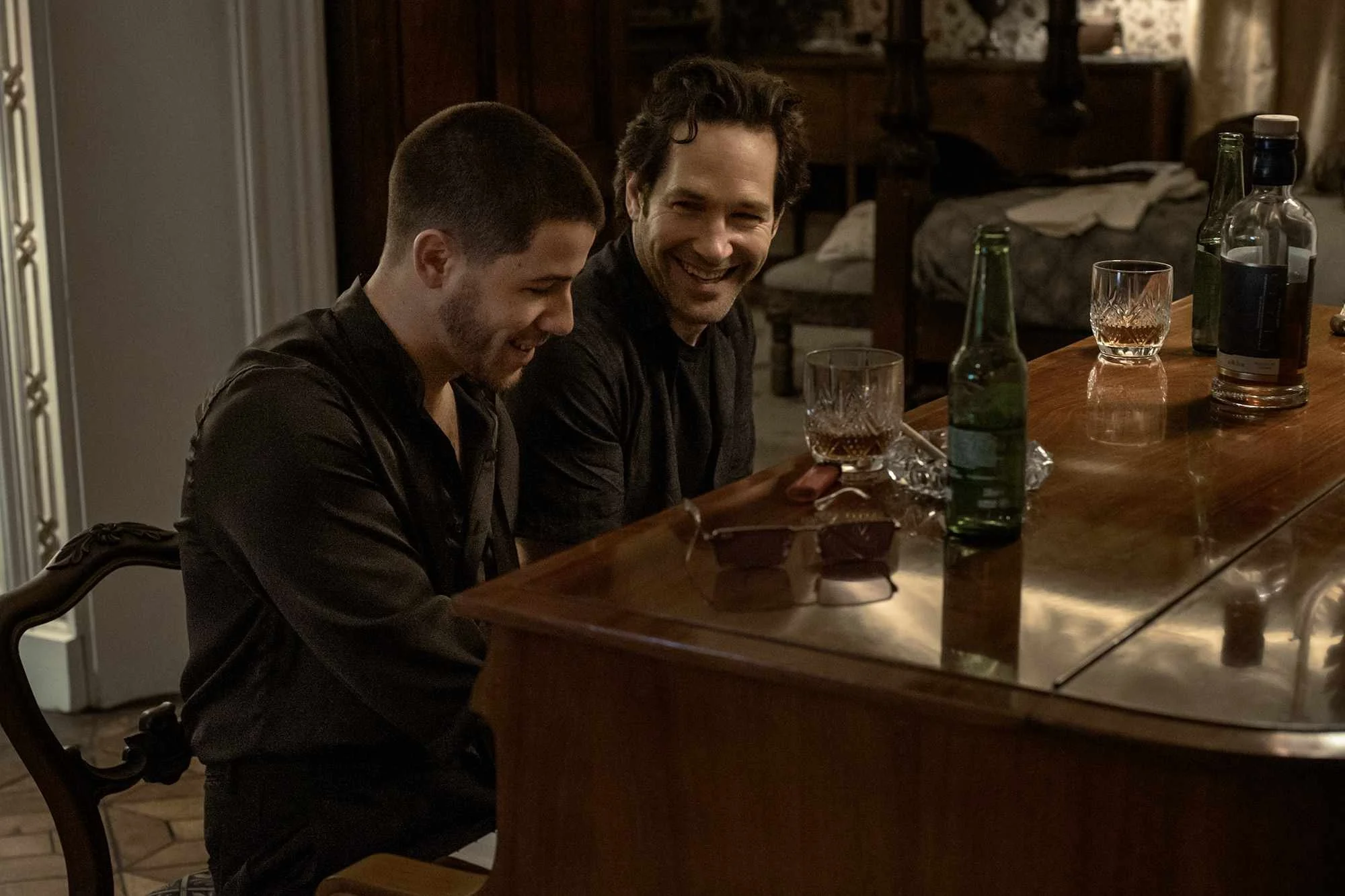
The two men cross paths at a lavish wedding gig. Danny is a guest with a microphone. Rick is the hired entertainment. After the show, they fall into a late‑night haze of drinks, weed, and musical experimentation. It is the kind of scene Carney excels at. Two musicians, from completely different worlds, find a creative spark together. They improvise, they push each other, they discover a shared rhythm. The chemistry is immediate and believable. It is also the emotional foundation of the entire film.
And that is where the plot stops for this review. Because Power Ballad works best when the audience discovers the story’s turns for themselves. What matters more is how the film handles the emotional fallout of that night, and how it uses music to explore questions of identity, ownership, and the longing to be seen.
Carney has always been interested in the tension between artistic integrity and personal fulfilment. Power Ballad continues that exploration with a light touch. Rick represents the artist who chose love and stability. Danny represents the artist who chose fame and is now grappling with the cost of that choice. Their dynamic becomes a way to examine the messy reality of collaboration. Who gets credit? Who gets forgotten? Who gets to claim authorship when creativity is shared?
The film also touches on the ethics of the modern music industry. Not in a heavy‑handed way, but with enough clarity to make the point. It acknowledges how easily art can be repackaged, reinterpreted, and marketed without acknowledging the people who shaped it. It also recognises that the industry’s obsession with shortcuts and instant success often clashes with the slow, vulnerable process of making something meaningful.
Rudd is perfectly cast as Rick. He captures the mix of optimism, regret, and stubborn pride that defines a middle‑aged musician who still carries a spark of the person he once hoped to be. Even when Rick spirals or makes questionable choices, Rudd keeps him grounded. Jonas, meanwhile, brings a surprising amount of humanity to Danny. He plays him as someone who wants to do the right thing but is constantly pulled toward the easier, shinier option. Their scenes together are the highlight of the film.
The music, as expected from Carney, is strong. The central song is an undeniable earworm, the kind of track that lingers long after the credits roll. The film knows it has a hit on its hands and uses it repeatedly, sometimes to the point of excess, but always with purpose. It becomes the emotional anchor of the story, representing different things to different characters. That duality gives the film more depth than its simple plot might suggest.
Visually, the film is unflashy. Carney favours natural light, intimate framing, and a sense of lived‑in realism. The Irish setting adds warmth without becoming a postcard. The supporting cast is solid, even if some characters feel underdeveloped or appear briefly before being shuffled aside. The pacing is brisk, occasionally too brisk, but the film never drags.
If there is a criticism, it is that the film sometimes feels a little too tidy. Conflicts are resolved quickly. Emotional beats arrive on schedule. Certain scenes hint at deeper themes that the film does not fully explore. But Carney’s films have always been more about feeling than complexity. Power Ballad is content to be a heartfelt, accessible story about two men trying to figure out who they are and what they want from their art.
What lingers is not the plot, but the emotional honesty. The film understands the quiet ache of wanting to be recognised. The longing to have your work acknowledged. The fear of being forgotten. It also understands the joy of connection, the thrill of collaboration, and the way music can bridge gaps between people who might otherwise never meet.
Power Ballad is not a groundbreaking film, but it is a good one. Warm, sincere, and easy to enjoy. It has a strong central song, two engaging performances, and enough emotional weight to make the experience satisfying. It may not be a film you revisit often, but it is one you will be glad you saw.
Coming to Aotearoa NZ cinemas June 4. Find your nearest screening here
Review written by Alex Moulton
