Mama Moo
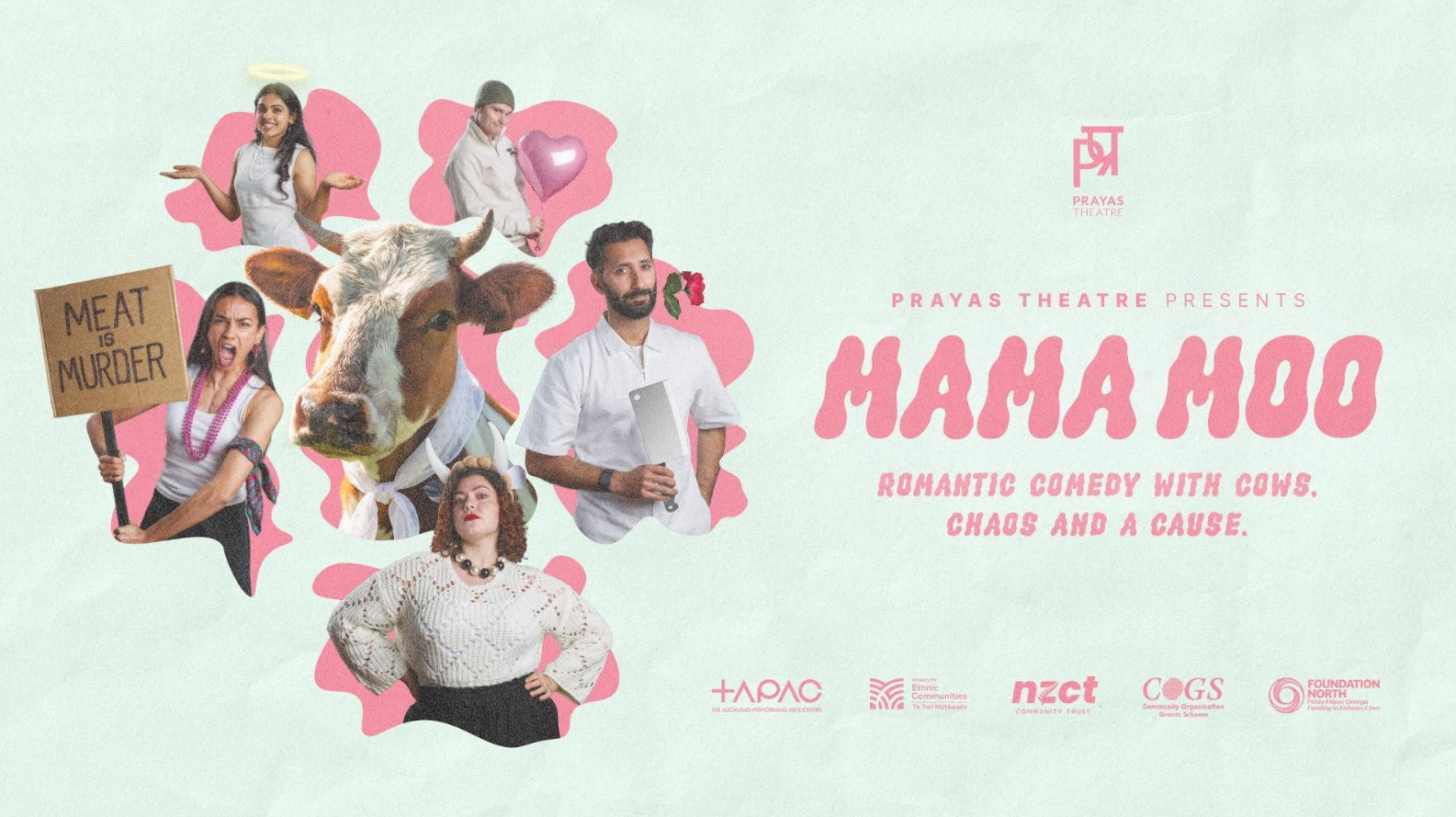
Presented by Prayas Theatre
A widowed butcher falls for an animal rights activist and must navigate the presence of his dead wife’s ghost, his own dark side and a talking cow spirit to win the activist’s love — all while fighting to save a calf’s life in court.
Mama Moo is one of those productions that becomes increasingly difficult to describe the longer it goes on. It begins as a relatively straightforward story about love, grief, and conflicting values, then gradually spirals into something far stranger. Ghosts appear. A devil starts offering guidance. A cow becomes unexpectedly influential. Logic takes a back seat to absurdity. Yet somehow, through all of the chaos, the production manages to maintain a surprisingly sincere emotional core.
Presented by Prayas Theatre and written by Auckland playwright Nimish Tanna, Mama Moo marks a bold step into absurdist comedy for a company more often associated with other forms of storytelling. The result is playful, ambitious, and unafraid to embrace the ridiculous. It is a production full of strange ideas, larger than life characters, and theatrical flair, but beneath the comedy sits a story about relationships, identity, tradition, and the challenge of finding common ground in a world increasingly divided by ideology.
The story centres on Siddhant, played by Rishabh Kapoor, a young butcher caught between conflicting forces in his life. His growing feelings for Sara, a passionate animal rights advocate, place him at odds with the world he inhabits professionally. At the same time, he finds himself surrounded by influences both real and imagined, all pushing him in different directions. Kapoor gives Siddhant an appealing uncertainty. He is not a natural hero, nor does he immediately take control of his own destiny. Instead, he spends much of the story caught in the middle, trying to navigate competing ideas of morality, loyalty, love, and self preservation.
That uncertainty makes him compelling.

Sara, played by Karishma Grebneff, is equally strong. She approaches the role with conviction and clarity, creating a character whose beliefs feel genuine rather than performative. Sara never wavers in her commitment to the causes she believes in, and that confidence provides a natural contrast to Siddhant's indecision. Their relationship forms the emotional backbone of the production and gives the absurdity something meaningful to orbit around.
The conflict they find themselves in is surprisingly relatable. While the specifics are heightened for comedic effect, the underlying questions about values, compromise, and understanding people who see the world differently feel grounded and recognisable.
Much of the narrative movement comes from three unconventional characters who only Siddhant can interact with. Mama Moo, The Devil, and Siddhant's late wife, Sheetal, act as competing influences, each attempting to steer him toward different outcomes. The dynamic creates a constant push and pull that drives much of the comedy while also serving as a visual representation of Siddhant's internal conflict.
Carla Newton's Mama Moo is calm, patient, and reassuring. She provides warmth and perspective amid the mounting madness. Raj Singh's Devil occupies the opposite end of the spectrum, delivering energy, disruption, and temptation with enthusiasm. Together they make strong foils for Siddhant, embodying competing philosophies while generating many of the production's funniest moments.
Of the three, Sheetal perhaps feels the least developed. Nikita Varma brings presence to the role, but the character often feels underutilised compared to the larger influence exerted by Mama Moo and The Devil. There are moments where additional exploration of Sheetal's role may have strengthened the emotional impact even further.

Among the supporting cast, Christopher Moore's Pita emerges as a standout. Warm, supportive, and frequently hilarious, Pita serves as one of the production's most grounded presences. He consistently finds opportunities for humour while maintaining the sincerity required to keep the emotional stakes intact.
Jehangir Homavazir also proves memorable whenever he appears. His comedic instincts are excellent, and the audience quickly learns that any scene featuring him is likely heading somewhere entertaining. Meanwhile, Subhamoy Ganguly delivers a performance filled with conviction. His character may not be particularly likeable, but Ganguly commits completely, creating someone whose worldview feels authentic even when it is frustrating.
Visually, Mama Moo makes excellent use of relatively modest resources.
Darryl Sang's set design and props divide the stage effectively. One side is dedicated to the abattoir, complete with hanging carcasses and transparent hygiene curtains that immediately establish the setting. The opposite side houses Siddhant's home, including a wonderfully unusual vertical bed that becomes a source of recurring comedy. Between the two sits a flexible central area that transforms repeatedly throughout the performance through the use of tables, cubes, props, and lighting.
The versatility of the design allows locations to shift rapidly without slowing the pace.
Lighting plays a significant role in making these transformations work. Scenes transition smoothly through changing colours, focused lighting states, and carefully directed attention. Entire environments appear to change before the audience's eyes. Emotional shifts are reinforced visually, while practical scene changes often occur unnoticed because the lighting naturally guides the eye elsewhere.
Director Margaret Mary Hollins makes strong use of the available space throughout. Characters enter from unexpected places, scenes overlap fluidly, and movement rarely feels static. There is also a significant amount of choreography integrated into the production. Not all of it serves a direct narrative purpose, but it consistently adds visual interest and helps maintain momentum.

The costuming deserves special mention. Mei Ling Lee demonstrates impressive inventiveness in the way animal forms and visual metaphors are represented. Rather than relying on elaborate effects, simple costume pieces and props are combined in clever ways that allow the audience's imagination to do the rest. It is a great example of theatre using suggestion rather than realism to create something memorable.
If there is one area where the production occasionally struggles, it is the sound design. While the music and audio atmosphere often add considerable depth to scenes, there were moments where technical issues became distracting. Feedback, static, and audio crackles occasionally pulled attention away from the performers. They are not frequent enough to significantly damage the experience, but they are noticeable.
Fortunately, the strength of the performances and writing ensures the show quickly recovers whenever these issues occur.
The production steadily escalates throughout its runtime. What begins as a quirky romantic conflict gradually snowballs into a wildly theatrical experience filled with increasing absurdity. By the time the show reaches its climactic courtroom sequence, it has fully embraced its chaotic nature. The scene is gloriously excessive and earns some of the night's biggest laughs.
Yet even at its most ridiculous, Mama Moo never loses sight of its emotional foundation.
Beneath the ghosts, devils, talking cows, and escalating nonsense is a story about people trying to understand each other despite profound differences. It questions assumptions, challenges traditions, and asks audiences to look beyond labels and ideologies to find the humanity in others.
Mama Moo is funny, creative, theatrical, and unapologetically strange. More importantly, it is a production with something meaningful to say beneath all of its absurdity. That balance between silliness and sincerity is what ultimately makes the journey worthwhile.
The season of Mama Moo runs from 21–26 September 2026, at TAPAC (The Auckland Performing Arts Centre). Purchase tickets here.
Review written by Alex Moulton
