RBG: OF Many, One
A Sydney Theatre Production
The second woman to be appointed to the US Supreme Court, Ruth Bader Ginsburg was both a trailblazer in the American judiciary and a fierce advocate for gender equality and reproductive rights. Her life is brought to the stage by the extraordinary pen of Olivier Award-winning Australian playwright and expert legal mind, Suzie Miller (Prima Facie). This story chronicles Ginsburg’s wins and dissents, traces her steps forward and the steps back, and brings you right into the room with her at the most pivotal moments of her life.
Sydney Theatre Company’s RBG: Of Many, One arrives with a sense of eerie timeliness. In a world where democratic norms feel increasingly brittle, returning to the life of Ruth Bader Ginsburg is not simply an act of remembrance. It becomes a way of taking stock. Of asking what has been lost, what remains, and what kind of courage is required to keep institutions alive when the ground beneath them is shifting.
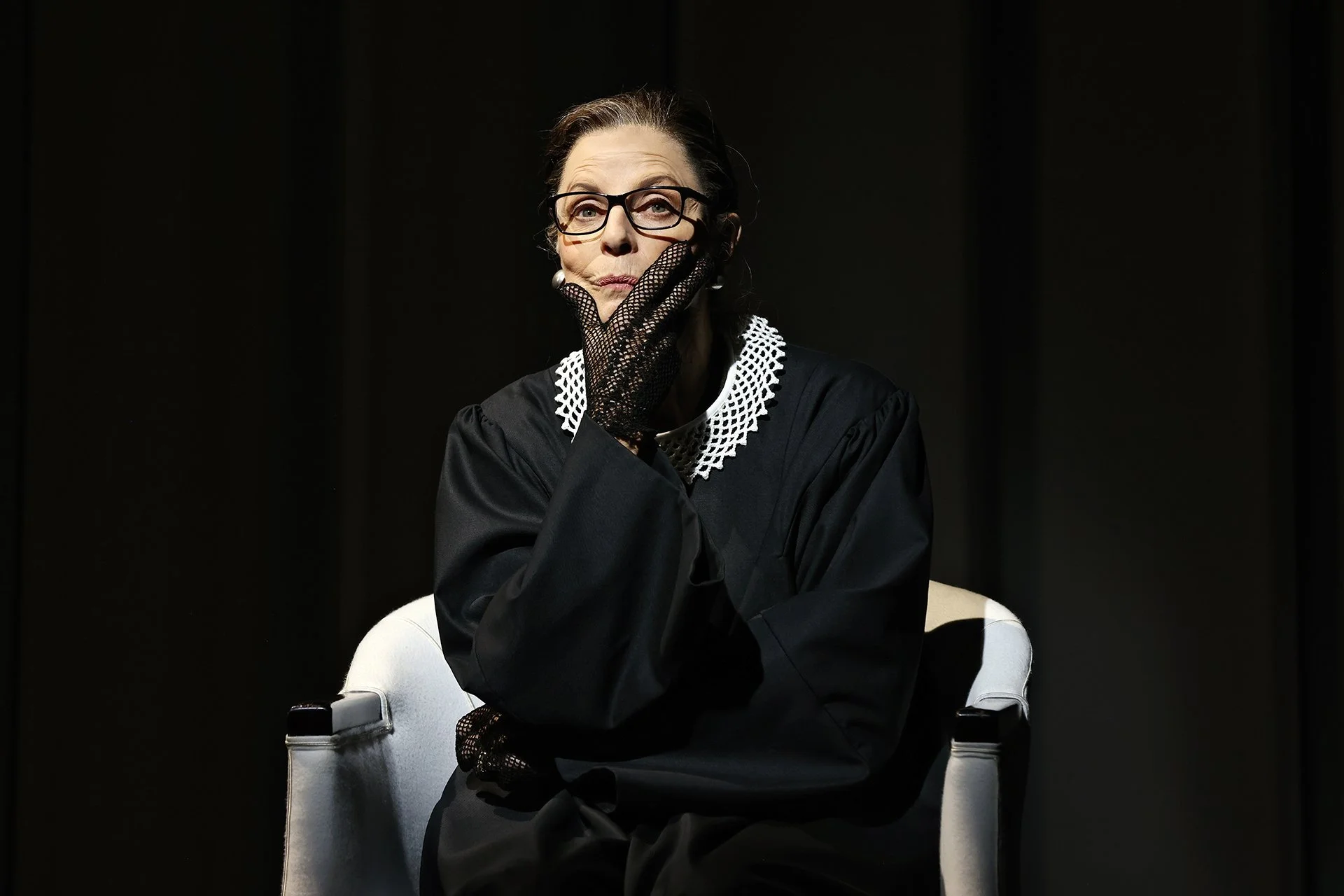
Suzie Miller’s script, paired with Heather Mitchell’s commanding solo performance, attempts something ambitious. It compresses a long, complicated life into a single evening, tracing the evolution of a woman who reshaped American law while navigating personal grief, political storms, and the weight of expectation. That scale shows in the opening scenes. The production takes a little while to find its rhythm. The early jumps between childhood, adulthood, and the cusp of her Supreme Court appointment feel slightly scattered, as if the play is still deciding which thread to pull first. But once it settles, the structure reveals itself. The initial looseness gives way to a steady, deliberate build.
The play begins with Ginsburg waiting for a phone call that will determine whether she will join the highest court in the United States. While she waits, memories surface. Not in a tidy chronological order, but in the way real memories do. One thought triggers another. A moment from her youth collides with a legal breakthrough decades later. Mitchell leans into this fluidity, allowing the audience to piece together the mosaic of RBG’s life rather than being handed a linear biography.
Mitchell’s performance is extraordinary in its detail. She shifts between eras with small, precise adjustments. A change in gait signals a younger version of Ruth. A firmer stance brings us into her judicial years. A softened voice reveals private moments of vulnerability. These transitions are so clean that the audience never feels lost, even as the play moves rapidly across time. Mitchell captures the steeliness that defined RBG’s public persona, but she also reveals the warmth, humour, and stubbornness that shaped her private world.
The production revisits several defining legal battles, not as dry case summaries but as emotional turning points. When she speaks about the fight for gender equality, the room becomes still. When she celebrates progress, the audience responds with genuine warmth. When she warns of the fragility of those gains, the tension is unmistakable. The play understands that the law is not abstract. It is lived experience. It is the difference between opportunity and exclusion. It is the difference between dignity and dismissal.
The second half of the play shifts into the years when RBG’s health was faltering and the political climate was becoming increasingly volatile. Her conversation with President Barack Obama becomes a central moment. It is not framed as a confrontation, but as a difficult, honest exchange between two people who understand the stakes. The play does not attempt to rewrite history or offer easy answers. Instead, it presents the complexity of her decision to remain on the bench, and the consequences that followed, with a level of nuance that avoids both condemnation and hero worship.
Despite the heavy subject matter, the production is far from solemn. It is threaded with humour, often sharp and unexpected. Mitchell finds the dry wit that made RBG so beloved, and she uses it to break tension at just the right moments. The Trump impression is a highlight. It is crude, exaggerated, and absolutely accurate. The audience roars, partly because it is funny, and partly because it feels like a release valve. The play knows exactly when to let the room breathe.
Visually, the production is understated. The set is stripped back to essentials, relying on light, shadow, and space to create shifts in time and tone. This simplicity allows Mitchell to command the stage without distraction. The design choices emphasise the idea that the story itself is enough. No elaborate scenery is needed when the performer can conjure entire decades with a gesture.
One of the most striking ideas in the play is the notion of dissent as an act of hope. RBG’s dissents are presented not as losses, but as seeds planted for future generations. The play suggests that change is rarely immediate. It is slow, often invisible, and sometimes only recognised long after the fact. This theme resonates strongly in the current political climate, where progress can feel fragile and setbacks overwhelming. The play argues that persistence matters, even when the outcome is uncertain.
The final scenes trace the end of RBG’s life with restraint. The production does not linger on tragedy, nor does it shy away from the consequences of her choices. It acknowledges the political fallout of her refusal to retire, and the shift in the Supreme Court that followed, without turning the moment into a lecture. Instead, it presents the complexity of her legacy and allows the audience to grapple with it themselves.
By the time the lights fade, the audience is fully invested. The standing ovation is immediate and heartfelt. The play may take time to warm up, and its early structure may feel scattered, but the emotional payoff is undeniable. It builds toward moments of such clarity and force that the audience cannot help but respond.
RBG: Of Many, One is not a straightforward biography. It is a meditation on conviction, resilience, and the cost of holding firm to one’s principles. It is a reminder that institutions are only as strong as the people who shape them, and that even the most powerful voices are still human. It is a portrait of a woman who believed deeply in the law, believed in equality, and believed that progress, no matter how slow, is always worth fighting for.
Performances of RBG: Of Many, One runs from 20 May - 7 June at Auckland’s ASB Waterfront Theatre. Purchase tickets
Review written by Alex Moulton
