Jacqueline Fahey: From Where I’m Looking (2026)
Screening as part of Doc Edge 2026
An exploration of Jacqueline Fahey’s life and career as a writer, artist and “sneaky” political activist.
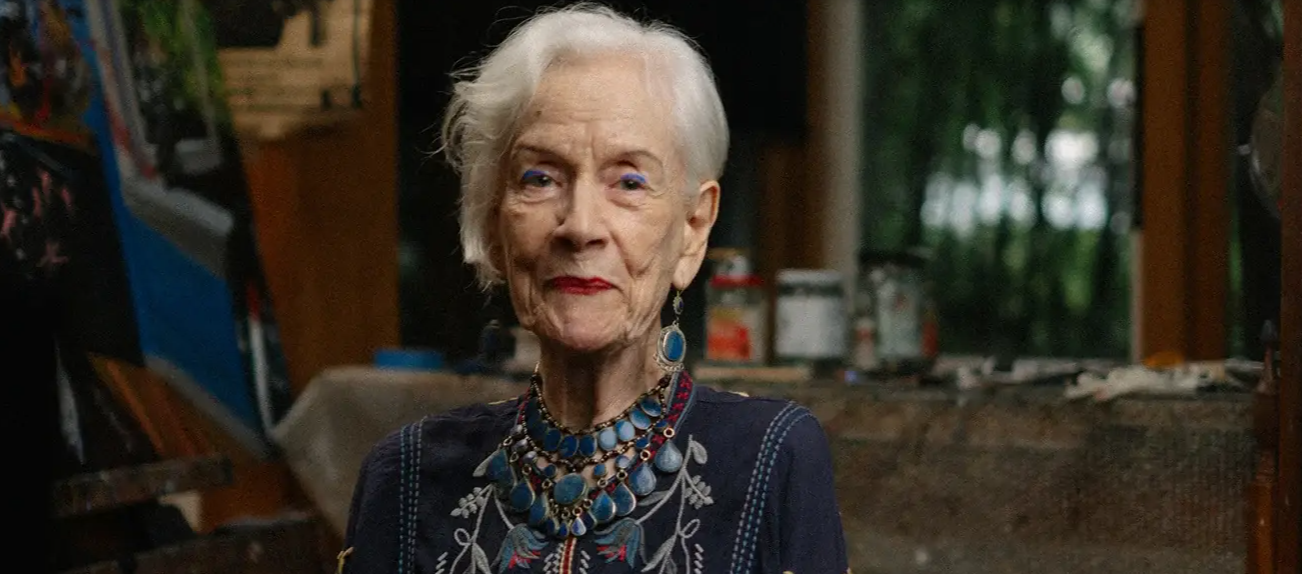
Jacqueline Fahey is an artists whose work documents a time, and interrogates it. This short documentary offers a vivid, intimate portrait of one of Aotearoa’s most uncompromising painters, capturing her at ninety‑six, still sharp, still mischievous, still politically charged, and still unwilling to soften her opinions for anyone.
Director Oliver Dawe approaches Fahey not as a relic of New Zealand art history, but as a living force. The film is structured around Fahey’s reflections, her memories, and her ongoing creative practice. She speaks with the clarity of someone who has spent nearly a century observing the world and refusing to accept its limitations. The result is a portrait that feels both historical and immediate, grounded in the past yet undeniably present.
Fahey’s story begins in Timaru, where she was born in 1929. She entered art school at sixteen, attending Canterbury College School of Art, now Ilam. It was there she formed friendships with Rita Angus and Doris Lusk, women who were already carving out space in a male‑dominated art world. Fahey often says they did not influence her style, but they influenced her sense of possibility. They showed her that painting could be a life, not a hobby. That conviction shaped everything that followed.
The documentary traces Fahey’s evolution from a young painter navigating the rigid gender expectations of mid‑century New Zealand to a mature artist whose work became synonymous with domestic rebellion. Her paintings are unmistakable. They are loud, colourful, crowded, and unapologetically female. Kitchens, lounges, gardens, daughters, mothers, arguments, clutter, and conversation. Fahey paints the domestic sphere not as a quiet refuge, but as a battleground of emotion, politics, and identity.
The film highlights how radical this was. In the 1950s and 60s, New Zealand’s art world was dominated by landscapes, abstraction, and masculine perspectives. Fahey painted women talking over cups of tea, children sprawled across couches, and interiors bursting with pattern and noise. Critics described her work as capturing “the claustrophobia of the female experience.” Fahey embraced that description. She wanted viewers to feel the pressure, the confinement, the intensity of domestic life. She wanted to elevate the everyday objects that defined women’s worlds: textiles, bouquets, clothing, crockery, radios, record players, wine glasses, gin bottles. Her paintings hum with sound. You can almost hear the arguments.
The documentary does not treat Fahey’s politics as an aside. It shows how deeply political she has always been, both in her work and her life. She helped organise the first gender‑balanced exhibition in Wellington in 1964. She painted the patriarchal suffocation of suburban life long before feminist discourse entered the mainstream. And even now, in her nineties, she continues to respond to global events. One of her recent works depicts an affluent woman turning away from televised atrocities in Gaza, a commentary on privilege, distraction, and selective empathy.
Fahey’s political commentary in the film is blunt, funny, and cutting. She rails against corporate greed, bourgeois complacency, and the cultural distractions designed to keep people docile. Football, yacht races, empty films, empty paintings. She compares modern society to the Roman Empire’s bread and circuses. Her voice is sharp, but never cruel. It is the voice of someone who has spent decades watching power operate and refuses to pretend it is benign.
Dawe’s direction is gentle but attentive. He allows Fahey to lead the film, letting her thoughts wander, circle back, and sharpen. Age is visible in her movements, but not in her mind. She speaks with the clarity of someone who has lived through multiple eras of social change and still sees the world with a painter’s eye. Her humour is dry. Her grudges are intact. Her empathy is fierce. She talks about women’s oppression with the same intensity she brings to global conflict. She does not separate the personal from the political.
The documentary also explores Fahey’s distinctive visual language. Her compositions often distort perspective, forcing viewers into tight domestic spaces where bodies, objects, and emotions collide. The camera lingers on these works, allowing the viewer to appreciate the detail: the way a bouquet is rendered with affection, the way a patterned curtain becomes a character, the way a television flickers in the corner of a chaotic room. Fahey’s paintings are not quiet observations. They are confrontations.
Later in her career, Fahey turned her attention to urban environments, applying her same vivid colour and emotional intensity to public spaces. The film touches on this shift, showing how her interest in domestic politics expanded into broader social commentary. Whether she is painting a living room or a city street, her work challenges viewers to reconsider how people live, communicate, and ignore one another.
What makes the documentary compelling is its refusal to treat Fahey as a museum piece. She is still working. Still thinking. Still arguing. Still painting about the culture of the time. The film captures her in her studio, surrounded by canvases, brushes, and memories. She speaks about her daughters, her mother, her friendships, her grudges, and her ongoing frustration with societal structures. She is reflective, but never nostalgic. She is still pushing.
The emotional resonance of the film comes from its honesty. Fahey is not softened for the camera. She is presented as she is: brilliant, opinionated, political, affectionate, and unfiltered. Her longevity is not framed as a miracle. It is framed as a continuation of a life lived with purpose. Nearly a century of observation has not dulled her empathy. If anything, it has sharpened it.
Jacqueline Fahey: From Where I’m Looking is a celebration of a woman who refused to paint quietly. It is a portrait of an artist who insisted that domestic life was worthy of serious attention, that women’s experiences were political, and that art could challenge the structures that shape society. It is also a reminder that age does not diminish conviction. Fahey remains one of New Zealand’s most distinctive voices, still looking, still questioning, still painting.
Screening as part of Doc Edge 2026. Check out the films and screenings here
Review written by Alex Moulton
