Seized (2026)
Screening as part of Doc Edge 2026
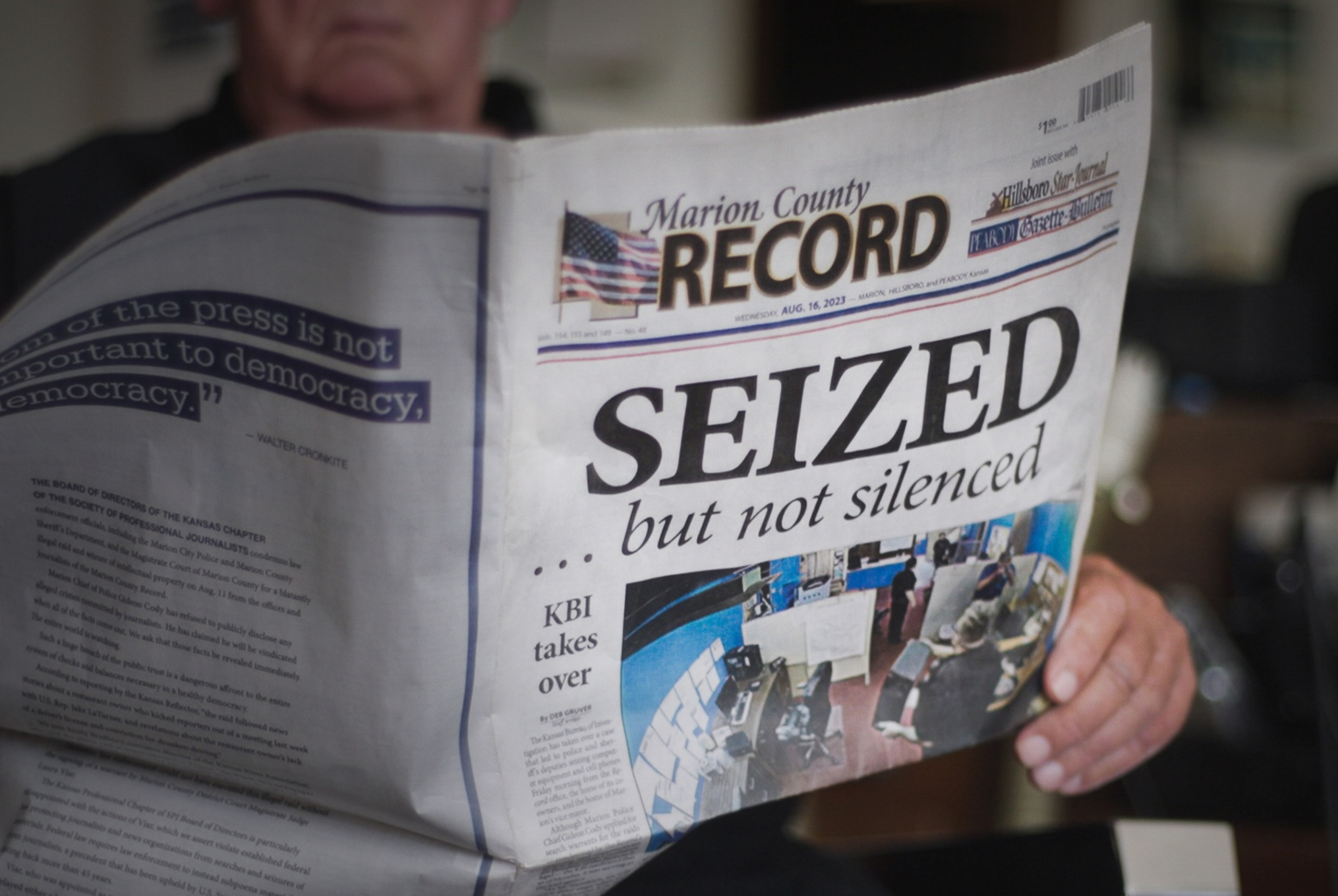
This film is a gripping, stranger-than-fiction investigative thriller that plunges audiences inside the troubling police raid on the Marion County Record. What begins as a shocking small-town incident quickly spirals into a story that reaches international headlines, exposing how corruption, politics, and decades-long tensions turned a quaint Kansas community into a microcosm of worldwide attacks on freedom of speech. Equal parts horrifying and hilarious, the film unfolds in real time through police body-cam and surveillance footage, revealing the raid’s chaos, the remarkable pettiness that led up to them, and the devastating personal toll on the reporters, including the tragic death of the paper’s 98-year-old co-publisher.
Some stories feel too strange to be real until you see them unfold piece by piece. Seized, directed by Jennifer Liese, is one of those stories. What begins as a seemingly minor dispute in a rural Kansas town spirals into a national flashpoint about press freedom, police power, and the fragility of constitutional protections. The documentary takes a local incident and reveals the fault lines running beneath it, showing how quickly a community can fracture when authority overreaches, and journalism refuses to back down.
The film centres on the 2023 police raid on the Marion County Record, a small family‑run newspaper in Marion, Kansas. Officers executed a search warrant on the newsroom and the homes of its staff, seizing computers, phones, and reporting materials. The raid was shocking enough on its own, but the aftermath became even more devastating. Ninety‑eight‑year‑old co‑owner Joan Meyer died the next day, her death widely believed to have been triggered by the stress of the raid. Overnight, a town of fewer than two thousand people became the centre of an international debate about the First Amendment.
Liese approaches the story with a tone that is both investigative and deeply human. She does not sensationalise the events, nor does she soften their impact. Instead, she allows the contradictions of small‑town life to speak for themselves. Marion is presented as a place where everyone knows everyone, where grudges linger for decades, and where the local paper is both a watchdog and a lightning rod. The documentary captures this complexity with care, showing residents who admire the paper’s tenacity and others who resent its scrutiny.
At the centre of the storm is editor Eric Meyer, a man whose commitment to journalistic integrity is matched only by his stubbornness. He is not portrayed as a saint. He is portrayed as someone who believes deeply in the role of the press, even when that belief makes him unpopular. If someone is arrested, it goes in the paper. If a public official behaves badly, he prints it. If children’s letters to Santa reveal educational gaps, he comments on it. In a town where personal relationships and public accountability collide, this approach creates friction.
The documentary’s structure mirrors the way people tell stories in real life. It is not linear. It loops back. It pauses to introduce a character whose relevance becomes clear later. It detours into local history, gossip, and long‑standing tensions. This narrative style works because the raid itself cannot be understood without understanding the ecosystem that produced it. The film shows how personal grievances, political ambitions, and bruised egos converged into a disastrous decision.
The catalyst for the raid is almost absurd in its pettiness. A tip about a restaurateur driving without a valid license. An accusation of identity theft. A police chief with questionable judgment. A judge who signs off on a warrant that should never have been approved. A former mayor with his own history in the mix. It is the kind of story that would feel exaggerated in fiction, yet here it is, documented through body‑cam footage, interviews, and public records. Liese lays out the tangled web with clarity, allowing viewers to see how something small escalated into something catastrophic.
One of the film’s strengths is its use of police body‑cam and surveillance footage. These recordings capture the raid in real time, showing officers rifling through desks, seizing equipment, and confronting Joan Meyer in her home. The footage is unsettling not because of violence, but because of the casualness with which constitutional boundaries are crossed. The raid feels both mundane and outrageous, a bureaucratic violation carried out with procedural calm.
The documentary also gives space to the townspeople, many of whom feel caught in the middle. Some believe the paper went too far. Others believe the police did. Some are embarrassed by the national attention. Others are angry that the town is being portrayed as backward. Liese allows these perspectives to coexist without forcing a conclusion. The film’s fairness is one of its most compelling qualities. It acknowledges that small‑town politics are messy, personal, and often contradictory.
A surprising source of levity comes from Finn Hartnett, a young intern who arrives at the paper just as the chaos begins. His presence adds a touch of workplace comedy to an otherwise heavy narrative. He covers parades, community events, and local celebrations, offering a reminder that most of Marion’s residents are ordinary people living ordinary lives. His earnestness contrasts with the absurdity of the situation, grounding the film in everyday reality.
But the emotional centre of Seized is Joan Meyer. Her death hangs over the documentary like a shadow. Liese handles this with restraint, avoiding melodrama. Instead, she lets the footage speak for itself. Joan’s anger during the raid, her disbelief, her sense of violation. The audience feels the weight of what happened without being told how to feel. Her passing becomes a symbol of the human cost of institutional overreach.
The documentary also raises difficult questions about accountability. Should the town be sued for damages? Should taxpayers bear the cost of the police chief’s actions? Should the paper have been more sensitive to community dynamics? Liese does not offer easy answers. She presents the arguments, the frustrations, and the fears, allowing viewers to grapple with the complexity.
What emerges is a portrait of a community wrestling with its identity. Marion is not simply a backdrop. It is a character. A microcosm of America, as one resident puts it. A place where constitutional principles collide with personal relationships. A place where journalism is both necessary and resented. A place where power can be abused quietly, until suddenly it is not quiet at all.
Seized ultimately becomes a defence of the press, not through grand speeches, but through the specificity of its storytelling. It shows how fragile press freedom can be, especially in places where oversight is limited and personal connections run deep. It shows how easily constitutional rights can be tested, even in a town most people have never heard of. And it shows why local journalism matters, even when it is uncomfortable.
The documentary ends not with resolution, but with recognition. A woman is dead. A town is divided. A police chief has resigned. Lawsuits are ongoing. The story is not finished. But the film makes one thing clear: the freedom of the press is not an abstract principle. It is lived, challenged, and defended in places like Marion, Kansas.
Seized is gripping, unsettling, and unexpectedly human. It is a reminder that democracy is not only tested in courts and capitals, but in small towns where the stakes feel personal, and the consequences are real.
Screening as part of Doc Edge 2026. Check out the films and screenings here
Review written by Alex Moulton
