Job

A Silo Theatre production, presented by arrangement with Concord Theatricals on behalf of Samuel French, Inc.
There’s been an incident. She’s a tech girlie with a heavy tote bag. He’s the therapist deciding if she’s safe to go back to work. She says she’s fine. He says he’s listening. What should be a simple psych evaluation spirals into power, panic, and doubt.
Job is a taut, unsettling two‑hander that traps its audience inside a therapist’s office and steadily tightens the screws. Written by Max Wolf Friedlich and directed by Shane Bosher, the production is a psychological drama that blends tech‑world satire, generational conflict, and thriller‑like escalation. It is dark, intriguing, and unapologetically relevant, offering a portrait of modern anxiety shaped by digital labour and the corrosive effects of online extremity.
The premise is simple. Jane, a young tech employee, arrives for a mandatory evaluation with Loyd, a crisis therapist. She wants to return to work. He wants to determine whether she is stable enough to do so. What begins as a routine appointment quickly becomes a spiralling interrogation of identity, trauma, and the blurred boundary between reality and perception. The play never leaves the office, yet the world outside feels enormous and threatening, thanks to sharp design choices and performances that vibrate with tension.
Olivia Tennet’s Jane is a force of nature. She plays the youthful, liberal tech worker with precision, capturing both her idealism and the corruption of values that comes from prolonged exposure to disturbing online content. Jane’s job has left her overstimulated, exhausted, and convinced that her vigilance is a moral duty. Tennet embodies this mental erosion with jittery physicality, rapid shifts in tone, and a constant undercurrent of panic. She is articulate, defensive, and deeply self‑critical, yet clings to the belief that her suffering proves her worth. Tennet’s performance is remarkable for its control. Every twitch, every vocal shift, every moment of stillness feels intentional.

Photo credit: Andi Crown photography
Stephen Lovatt’s Loyd provides the counterbalance. He enters as a figure of comfort and stability, a therapist who listens carefully and responds with measured calm. Lovatt plays him with quiet authority, revealing layers of vulnerability without ever losing the sense of professional grounding. As the session intensifies, that stability begins to waver. Lovatt shows how a man who prides himself on composure can be shaken by the force of someone else’s unravelling. His performance is subtle, empathetic, and increasingly tense as the play progresses.
The dynamic between Tennet and Lovatt is the engine of the production. Their exchanges feel like a battle of intellects, a negotiation of truth, and a desperate attempt to understand one another. The chemistry is sharp, intimate, and combative. Their conversation shifts between therapy, interrogation, and something closer to hostage negotiation, creating a sense of unpredictability that keeps the audience on edge.
Bosher’s direction keeps the tension taut. The pacing is tight, the tonal shifts are controlled, and the emotional escalation feels organic. The play moves between dark humour, psychological drama, and thriller‑like intensity without losing coherence. Bosher allows moments of silence to linger, lets panic flare without melodrama, and ensures that the audience never fully relaxes. The result is a performance that feels alive, volatile, and deeply uncomfortable in the best way.
The design elements elevate the production significantly. The set, designed by John Verryt, is basic but professional: chairs, a rug, a wood floor, small decorations. Everything feels like an organic part of a therapist’s office. The simplicity works. It grounds the play in reality, making the psychological fractures that follow feel even more jarring.
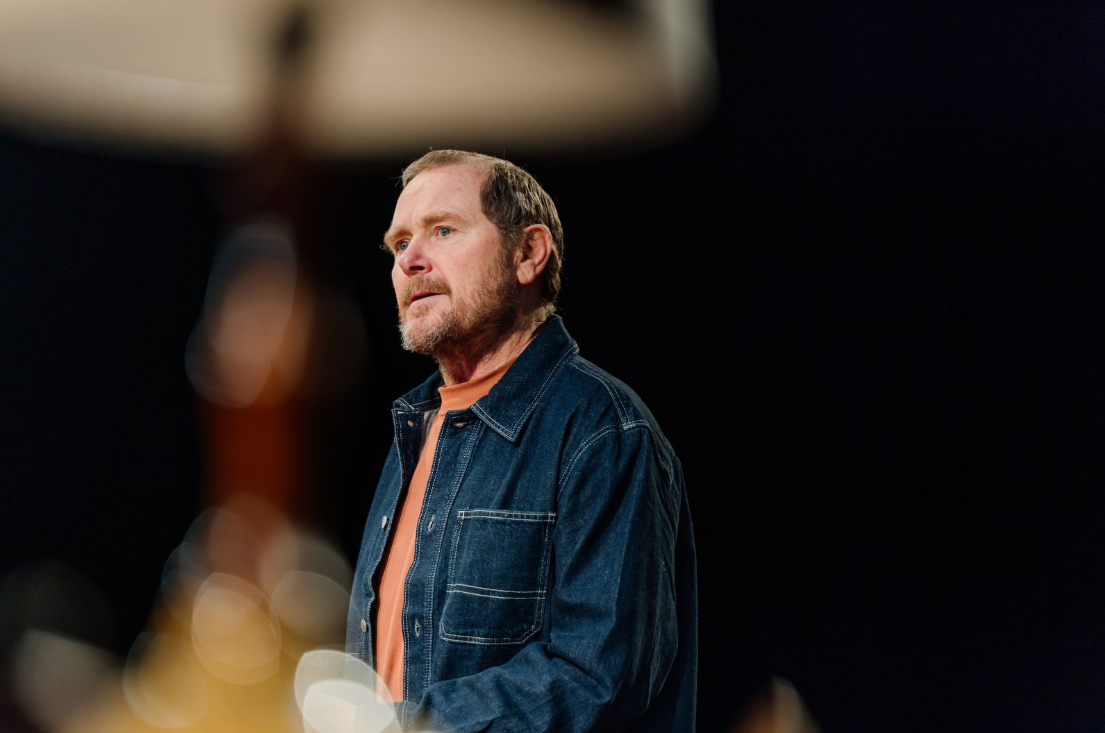
Photo credit: Andi Crown photography
Lighting and sound, designed by Sean Lynch and Paul McLaney, play an integral role in heightening emotion. Bright flashes accompany moments of intensity. Sudden blackouts interrupt the characters’ rhythm. A flurry of offset lights and intrusive sounds create unexpected moments of dysphoria. These interruptions are internal ruptures, occurring inside someone’s mind rather than in the physical room. The cast’s lack of reaction reinforces this idea, blurring the line between external reality and psychological disturbance. The production uses these elements with precision, creating a sensory landscape that mirrors the characters’ unravelling.
The script understands the overwhelming speed of online life. Jane’s job has exposed her to the darkest corners of the internet, and the play captures how constant exposure to harm can warp a person’s sense of truth. Her panic becomes a form of purpose. Her anxiety becomes a familiar rhythm. Friedlich’s writing explores how digital labour erodes boundaries, how information overload distorts perception, and how modern work can consume a person’s identity.
Generational tension is woven throughout the play. Jane sees the internet as a battleground where she must fight to protect others. Loyd sees it as a destabilising force that has reshaped society faster than people can adapt. Their debate touches on privacy, mental health, responsibility, and the myth of digital heroism. The play never moralises. Instead, it presents two perspectives that clash, overlap, and challenge each other.
The emotional heart of the production lies in the characters’ attempts to make sense of suffering. Jane believes her pain proves her value. Loyd believes her pain is a warning. Their conversation becomes a meditation on purpose, identity, and the human cost of modern work. The biblical echo of the title is subtle but present. Jane’s fixation on endurance mirrors the ancient story of Job, a figure who believed suffering was a measure of worth. The play reframes this idea through a contemporary lens, asking what happens when a person becomes convinced that their suffering is meaningful, necessary, or deserved.
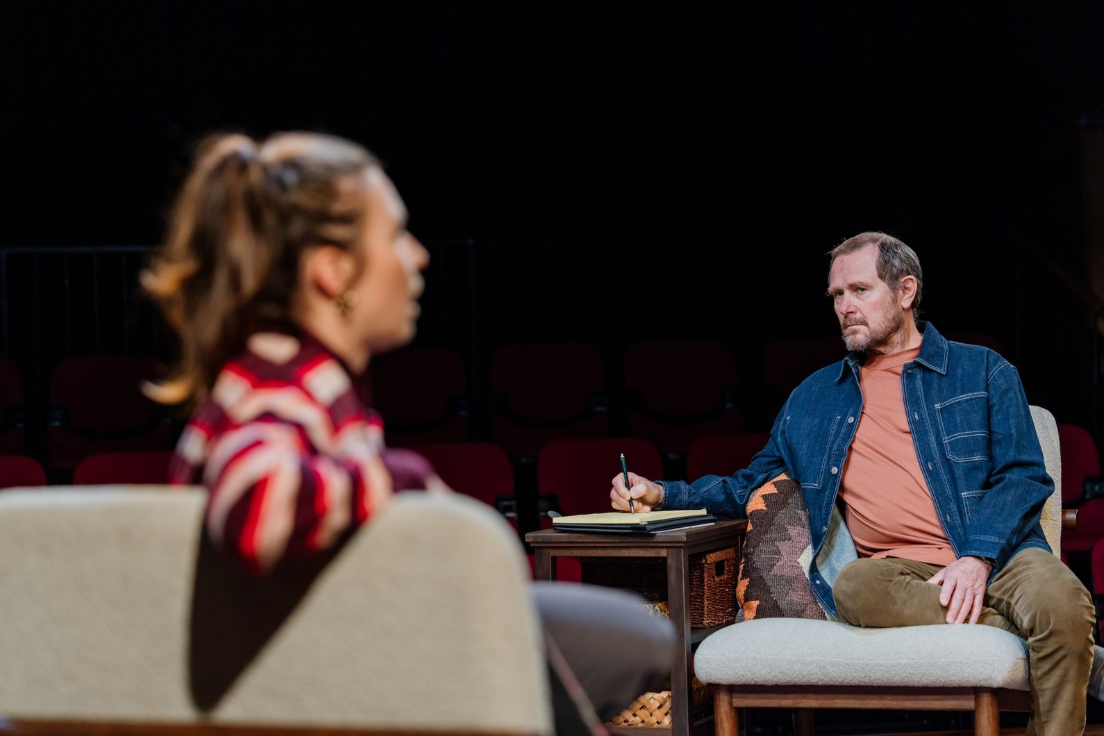
Photo credit: Andi Crown photography
The final stretch of the play becomes increasingly intense. Without revealing specifics, the ending arrives in a flurry of twists that attempt to pull the details of the last 80 minutes into a single shocking reveal. Its success will vary from person to person, but it certainly provokes discussion. It is rare to find a play that leaves audiences debating what they saw, what they think happened, and what it all means. Job manages that.
The production also demonstrates care for its audience and cast. Given the subject matter, it is reassuring to see that a wellbeing and therapy consultant was involved, and that mental health resources were provided. The play is dark, likely triggering for some, and unapologetic in its depiction of psychological collapse. That support matters.
Ultimately, Job is a tense, claustrophobic, and thought‑provoking piece of theatre. It is anchored by two well-executed performances, elevated by sharp design, and driven by a script that understands the psychological toll of modern digital life. It is unsettling, relevant, and worth seeing.
The season of Job runs from 3 – 20 September at Auckland’s Q Theatre. Purchase tickets here.
Review written by Alex Moulton
